Friday, October 26, 2018

Microsoft has no problem taking the $10B JEDI cloud contract if it wins

The Pentagon’s $10 billion JEDI cloud contract bidding process has drawn a lot of attention. Earlier this month, Google withdrew, claiming ethical considerations. Amazon’s Jeff Bezos responded in an interview at Wired25 that he thinks that it’s a mistake for big tech companies to turn their back on the US military. Microsoft president Brad Smith agrees.

In a blog post today, he made clear that Microsoft intends to be a bidder in government/military contracts, even if some Microsoft employees have a problem with it. While acknowledging the ethical considerations of today’s most advanced technologies like artificial intelligence, and the ways they could be abused, he explicitly stated that Microsoft will continue to work with the government and the military.

“First, we believe in the strong defense of the United States and we want the people who defend it to have access to the nation’s best technology, including from Microsoft,” Smith wrote in the blog post.

To that end, the company wants to win that JEDI cloud contract, something it has acknowledged from the start, even while criticizing the winner-take-all nature of the deal. In the blog post, Smith cited the JEDI contract as an example of the company’s desire to work closely with the U.S. government.

“Recently Microsoft bid on an important defense project. It’s the DOD’s Joint Enterprise Defense Infrastructure cloud project – or “JEDI” – which will re-engineer the Defense Department’s end-to-end IT infrastructure, from the Pentagon to field-level support of the country’s servicemen and women. The contract has not been awarded but it’s an example of the kind of work we are committed to doing,” he wrote.

He went on, much like Bezos, to wrap his company’s philosophy in patriotic rhetoric, rather than about winning lucrative contracts. “We want the people of this country and especially the people who serve this country to know that we at Microsoft have their backs. They will have access to the best technology that we create,” Smith wrote.

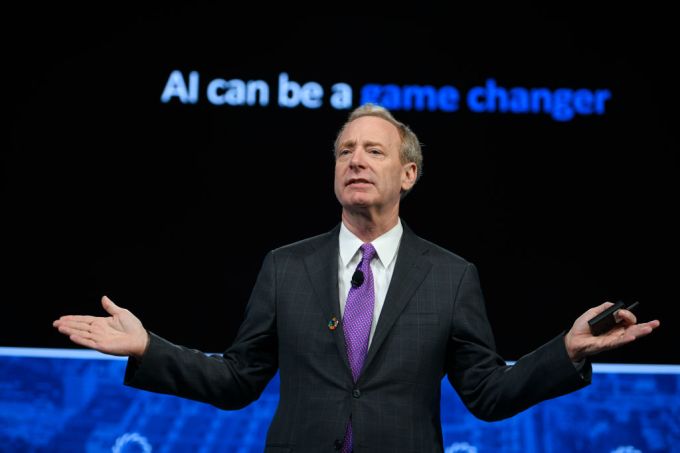
Microsoft president Brad Smith. Photo: Riccardo Savi/Getty Images

Throughout the piece, Smith continued to walk a fine line between patriotic duty to support the US military, while carefully conceding that there will be different opinions in a large and diverse company population (some of whom aren’t US citizens). Ultimately, he believes that it’s critical that tech companies be included in the conversation when the government uses advanced technologies.

“But we can’t expect these new developments to be addressed wisely if the people in the tech sector who know the most about technology withdraw from the conversation,” Smith wrote.

Like Bezos, he made it clear that the company leadership is going to continue to pursue contracts like JEDI, whether it’s out of a sense of duty or economic practicality or a little of both — whether employees agree or not.


from Microsoft – TechCrunch https://techcrunch.com/2018/10/26/microsoft-has-no-problem-taking-the-10b-jedi-cloud-contract-if-it-wins/

You can now use Alexa to move around inside apps like Netflix and Hulu on Fire TV Cube

Amazon is making it easier to use Alexa to do more than launch apps and streaming services on Fire TV devices, but to also navigate once inside them. The company confirmed it quietly launched an update specifically for Fire TV Cube devices that allows device owners to use Alexa instead of a remote control for doing things like making profile selections, moving up and down or left and right, as well as selecting items.

In other words, Fire TV Cube owners can now use Alexa to navigate their Fire TV, with no remote control required.

The feature began its rollout a few weeks ago, the company told TechCrunch, but reached all Fire TV Cube devices around a week ago. AFTVNews was the first spot the new navigation option in the wild. 

According to Amazon, the decision to enable Alexa to take place of a remote control was based on customer feedback.

“We got a deeper understanding that customers want the ability to use their voice to select, browse and navigate through their favorite apps, just like they can on the Fire TV home screen,” a spokesperson said.

To use the feature inside an app, you can say things like “Alexa, go up,” “Alexa, move right,” or “Alexa, scroll down,” then pick what you want to watch by saying “Alexa, select” (or “select this” or “select that.”)

“Think of it like a d-pad for you voice,” the spokesperson added.

The voice navigation is already supported across a range of apps, including Hulu, Netflix, ESPN, HBO Go, HBO Now, FOX Now, FXNow, ABC, FilmStruck, Boomerang, Tubi TV, Red Bull TV, Cartoon Network, Hallmark Movies Now, DramaFever, The CW, and CW Seed, with more being added regularly.

While it could be a bit awkward to use Alexa to browse through many screens of content – the way you do when in search of something to watch – if you’re just moving down a couple of rows to resume a show on Netflix, for example, it’s less of a bother.

The feature could also be useful from an accessibility standpoint, as it provides a way to navigate through the Fire TV interface without having to grip a remote and use your fingers and/or thumb to press buttons. And it could help users with low vision, who have trouble seeing the correct buttons on the remote.

Fire TV Cube hands-free navigation demo, courtesy AFTVnews on YouTube

Unfortunately, the new voice navigation is a Fire TV Cube-only feature for now. The feature was enabled on Fire TV devices over the past few weeks, but a software update began to roll out on October 19 which includes an explanation to end users, so they’re aware of the new functionality. Amazon didn’t say if or when it would arrive on other Fire TV platforms.


from Amazon – TechCrunch https://techcrunch.com/2018/10/26/you-can-now-use-alexa-to-move-around-inside-apps-like-netflix-and-hulu-on-fire-tv-cube/

Microsoft closes its $7.5B purchase of code-sharing platform GitHub

After getting EU approval a week ago, today Microsoft’s acquisition of GitHub, the Git-based code sharing and collaboration service with 31 million developers, has officially closed. The Redmond, WA-based software behemoth first said it would acquire GitHub for $7.5 billion in stock in June of this year, and after the acquisition closed it would continue to run it as an independent platform and business.

The acquisition is yet another sign of how Microsoft has been doubling down on courting developers and presenting itself as a neutral partner to help them with their projects.

That is because, despite its own very profitable proprietary software business, Microsoft also has a number of other businesses — for example, Azure, which competes with AWS and Google Cloud — that rely heavily on it being unbiased towards one platform or another. And GitHub, Microsoft hopes, will be another signal to the community of that position.

In that regard, it will be an interesting credibility test for the companies.

As previously announced, Nat Friedman, who had been the CEO of Xamarin (another developer-focused startup acquired by Microsoft, in 2016), will be CEO of the company, while GitHub founder and former CEO Chris Wanstrath will become a Microsoft technical fellow to work on strategic software initiatives. (Wanstrath had come back to his CEO role after his co-founder Tom Preston-Werner resigned following a harassment investigation in 2014.)

Friedman, in a short note, said that he will be taking over on Monday, and he also repeated what Microsoft said at the time of the deal: GitHub will be run as an independent platform and business.

This is a key point because there has been a lot of developer backlash over the deal, with many asking if GitHub would become partial or focused more around Microsoft-based projects  or products.

“We will always support developers in their choice of any language, license, tool, platform, or cloud,” he writes, noting that there will be more tools to come. “We will continue to build tasteful, snappy, polished tools that developers love,” he added.

One of those, he noted, will be further development and investment in Paper Cuts, a project it launched in August that it hopes will help address some of the gripes that its developer-users might have with how GitHub works that the company itself hadn’t been planning to address in bigger product upgrades. The idea here is that GitHub can either help find workarounds, or this will become a feedback forum of its own to help figure out what it should be upgrading next on the site.

Of course, the need to remain neutral is not just to keep hold of its 31 million developers (up by 3 million since the deal was first announced), but to keep them from jumping to GitHub competitors, which include GitLab and Bitbucket.


from Microsoft – TechCrunch https://techcrunch.com/2018/10/26/microsoft-closes-its-7-5b-purchase-of-code-sharing-platform-github/

The antidote

It’s worth picking a philosophy that’s self correcting.

The antidote to junk science is more science, good science. Science is a self-correcting process, where transparency leads to improvement.

The antidote to bad engineering is more engineering. Engines and bridges run better today than they did a hundred years ago.

The antidote to blind obedience to unexamined edicts and principles, though, is not more obedience. It doesn’t self correct. It gets worse.


[For those interested in constructive innovation instead of obedience, please consider the altMBA. Today’s the early deadline for our next session.]


from Seth Godin's Blog on marketing, tribes and respect https://feeds.feedblitz.com/~/576794362/0/sethsblog~The-antidote/

Thursday, October 25, 2018

Amazon shares fall as record profits are offset by conservative holiday forecasts

Amazon is still raking in the cash, but its slower than expected customer growth in its web services offerings and a weaker than expected sales outlook for the holiday season shook investor confidence and caused the stock to slide around 5 percent in after-hours trading.

Profits for the company continued to soar, reaching $2.9 billion, or $5.75 per share, up from $2.5 billion in the second quarter, and handily beating analysts’ estimates of $3.14 per share. Those earnings were offset by slower revenue growth at $56.6 billion versus the $57.1 billion analysts had expected.

Potentially more worrying for investors were the figures that Amazon predicted for the all-important holiday fourth quarter. The company said it was expecting $66.5 billion to $72.5 billion in sales, versus analyst estimates of somewhere around $73.8 billion for the giant e-commerce company.

Sales from Amazon Web Services also likely weighed on investors’ minds. The company managed to just about hit analyst expectations, with sales from Web Services coming in at around $6.7 billion, but that number indicates that growth for AWS is slowing.

The company, never afraid of taking big swings on new products and services, launched a new family of devices in September (that included integrations for Alexa with pretty much everything but the kitchen sink).

Those Alexa-enabled devices continue to be a bright spot for the company, and one that will hopefully lead to higher sales during the holiday season. Alexa-enabled home devices now include 20,000 gadgets from 3,500 brands — including, somewhat inexplicably, the AmazonBasics Microwave.

Amazon Web Services weren’t the only area that showed slowing growth, with international sales also slowing seeing $15.5 billion in sales versus analyst expectations of $16.5 billion in international revenue.

Amazon’s predictions for the fourth quarter would mean sales growth of somewhere between 10 percent and 20 percent. That’s a lower rate than the 30 percent growth rate the company enjoyed in the fourth quarter last year. Meanwhile, revenue predictions for the fourth quarter would be flat on an annual basis, which is something that investors don’t love.

Ultimately, the company said it was seeing good cost performance as it wrings more out of the existing customers that it has despite facing headwinds coming from its commitment to increase compensation among some hourly workers to $15 per hour.

Both Amazon’s Prime service and AWS continue to be the gifts that keep on giving for the company.
Amazon announced earlier in the year that it had snagged more than 100 million members. After hitting that milestone, the company summarily raised the price of a subscription.

The company continues to push hard into offline retail, expanding its Amazon Go store and opening a new four-star store in New York.


from Amazon – TechCrunch https://techcrunch.com/2018/10/25/amazon-shares-fall-as-record-profits-are-offset-by-conservative-holiday-forecasts/

Fleksy’s keyboard grabs $800k+ via equity crowdfunding

The dev team that’s now engineering the Fleksy keyboard app has raised more than $800,000 via an equity crowdfunding route.

As we reported a year ago, the development of Fleksy’s keyboard has been taken over by the Barcelona-based startup behind an earlier keyboard app called ThingThing.

The team says their new funding raise — described as a pre-Series A round — will be put towards continued product development of the Fleksy keyboard, including the core AI engine used for next word and content prediction, plus additional features being requested by users — such as swipe to type. 

Support for more languages is also planned. (Fleksy’s Android and iOS apps are currently available in 45+ languages.)

Their other big push will be for growth: Scaling the user-base via a licensing route to market in which the team pitches Android OEMs on the benefits of baking Fleksy in as the default keyboard — offering a high degree of customization, alongside a feature-set that boasts not just speedy typing but apps within apps and extensions. 

The Fleksy keyboard can offer direct access to web search within the keyboard, for example, as well as access to third party apps (in an apps within apps play) — to reduce the need for full app switching.

This was the original concept behind ThingThing’s eponymous keyboard app, though the team has refocused efforts on Fleksy. And bagged their first OEMs as licensing partners.

They’ve just revealed Palm as an early partner. The veteran brand unveiled a dinky palm-sized ‘ultra-mobile’ last week. The tiny extra detail is that the device runs a custom version of the Fleksy keyboard out of the box.

With just 3.3 inches of screen to play with, the keyboard on the Palm risks being a source of stressful friction. Ergo enter Fleksy, with gesture based tricks to speed up cramped typing, plus tried and tested next-word prediction.

ThingThing CEO Olivier Plante says Palm was looking for an “out of the box optimized input method” — and more than that “high customization”.

“We’re excited to team up with ThingThing to design a custom keyboard that delivers a full keyboard typing experience for Palm’s ultra mobile form factor,” adds Dennis Miloseski, co-founder of Palm, in a statement. “Fleksy enables gestures and voice-to-text which makes typing simple and convenient for our users on the go.”

Plante says Fleksy has more OEM partnerships up its sleeve too. “We’re pending to announce new partnerships very soon and grow our user base to more than 25 million users while bringing more revenue to the medium and small OEMs desperately looking to increase their profit margins — software is the cure,” he tells TechCrunch.

ThingThing is pitching itself as an neutral player in the keyboard space, offering OEMs a highly tweakable layer where the Qwerty sits as its strategy to compete with Android’s keyboard giants: Google’s Gboard and Microsoft-owned SwiftKey. 

“We changed a lot of things in Fleksy so it feels native,” says Plante, discussing the Palm integration. “We love when the keyboard feels like the brand and with Palm it’s completely a Palm keyboard to the end-user — and with stellar performance on a small screen.”

“We’ve beaten our competitor to the punch,” he adds. 

That said, the tiny Palm (pictured in the feature image at the top of this post) is unlikely to pack much of a punch in marketshare terms. While Palm is a veteran — and, to nerds, almost cult — brand it’s not even a mobile tiddler in smartphone marketshare terms.

Palm’s cute micro phone is also an experimental attempt to create a new mobile device category — a sort of netbook-esque concept of an extra mobile that’s extra portable — which looks unlikely to be anything other than extremely niche. (Added to its petite size, the Palm is a Verizon exclusive.)

Even so ThingThing is talking bullishly of targeting 550M devices using its keyboard by 2020.

At this stage its user-base from pure downloads is also niche: Just over 1M active users. But Plante says it has already closed “several phone brands partnerships” — saying three are signed, with three more in the works — claiming this will make Fleksy the default input method in more than 20-30 million active users in the coming months. 

He doesn’t name any names but describes these other partners as “other major phone brands”.

The plan to grow Fleksy’s user-base via licensing has attracted wider investor backing now, via the equity crowdfunding route. The team had initially been targeting ($300k). In all they’ve secured $815,119 from 446 investors.

Plante says they went down the equity crowdfunding route to spread their pitch more widely, and get more ambassadors on board — as well as to demonstrate “that we’re a user-centric/people/independent company aiming big”.

“We are keen to work and fully customize the keyboard to the OEM tastes. We know this is key for them so they can better compete against the others on more than simply the hardware,” he says, making the ‘Fleksy for OEMs’ pitch. “Today, the market is saturated with yet another box, better camera and better screen…. the missing piece in Android ecosystem is software differences.”

Given how tight margins remain for Android makers it remains to be seen how many will bite. Though there’s a revenue share arrangement that sweetens the deal.

It is also certainly true that differentiation in the Android space is a big problem. That’s why Palm is trying its hand at a smaller form factor — in a leftfield attempt to stand out by going small.

The European Union’s recent antitrust ruling against Google’s Android OS has also opened up an opportunity for additional software customization, via unbundled Google apps. So there’s at least a chance for some new thinking and ideas to emerge in the regional Android smartphone space. And that could be good for Spain-based ThingThing.

Aside from the licensing fee, the team’s business model relies on generating revenue via affiliate links and its fleksyapps platform. ThingThing then shares revenue with OEM partners, so that’s another carrot for them — offering a services topper on their hardware margin.

Though that piece will need scale to really spin up. Hence ThingThing’s user target for Fleksy being so big and bold.

“We’re working with brands in order to bring them into any apps where you type, which unlocks brand new use cases and enables the user to share conveniently and the brand to drive mobile traffic to their service,” says Plante. “On this note, we monetize via affiliate/deep linking and operating a fleksyapps Store.”

ThingThing has also made privacy by design a major focus — which is a key way it’s hoping to make the keyboard app stand out against data-mining big tech rivals.


from Microsoft – TechCrunch https://techcrunch.com/2018/10/25/fleksys-keyboard-grabs-800k-via-equity-crowdfunding/
Confirmed: ShopRunner acquires Spring, raises $40M

ShopRunner chief executive Sam Yagan conquered the online dating world. Can he conquer the e-commerce world, too?

Hot off the heels of its first profitable year, ShopRunner is announcing its first infusion of venture funding under Yagan, an acquisition of the shopping app Spring and, sources tell TechCrunch, it’s readying a major overhaul to its mobile app, signaling what could be a new era for the company.

Yagan, the co-founder of OkCupid, former CEO and vice chairman of The Match Group and managing director of the venture fund Corazon Capital joined ShopRunner in 2016 to test the waters of online retail.

“If you look at founding OkCupid, running Match and incubating Tinder, arguably, I had my hands on the three most important dating businesses ever,” Yagan told TechCrunch. “Finally, I was like, ‘what else is there?’ I am either going to the grave as the online dating guy, or this was the moment.”

Yagan replaced former PayPal president Scott Thompson as ShopRunner’s CEO, moved the Alibaba-backed subscription-based digital shopping company from Silicon Valley to his hometown, Chicago, and readied for battle against Amazon.

ShopRunner teams with mid- to high-end retailers to offer its paying members free two-day shipping and free returns on their sites, taking a small cut of each purchase. As much as it might like to, it doesn’t compete with Amazon Prime. It doesn’t even have a centralized marketplace where users can shop all the ShopRunner partner brands at once, but that may change.

This week, it announced a $40 million investment from August Capital, bringing its total equity funding to around $140 million since it was founded in 2009. The company says it plans to use the cash for product development, data science and to amp up its M&A strategy. It’s already begun the latter, confirming to TechCrunch that it’s acquired Alan and David Tisch’s Spring, a deal first reported by Recode.

Yagan declined to disclose both ShopRunner’s latest valuation and the terms of the Spring acquisition. Though he did say ShopRunner’s valuation is in the “hundreds of millions” range and that they had purchased Spring’s platform and 30 of its employees, a majority of which are engineers.

ShopRunner did not take on all of Spring’s employees. Why? Yagan said it was because the two were similar companies and there wasn’t a need for Spring’s entire team. As a result, Spring’s remaining employees, a mix of engineers and otherwise, are joining real estate tech startup Compass as part of a separate transaction, Spring’s CEO Alan Tisch confirmed to TechCrunch.

Backed with $105 million in VC funding, Spring had reportedly struggled to scale and had drifted from the mobile-first strategy it touted right out of the gate. TechCrunch’s Ingrid Lunden has more on this and Compass’ acquihire.

ShopRunner and Spring had some preexisting ties. Recode reports that Michael Rubin, the billionaire owner of ShopRunner via Kynetic, ShopRunner’s parent company, is close friends with Alan. Moving forward, Alan is serving as an advisor to ShopRunner, while Spring’s president Marshall Porter will continue to lead the startup.

“Shopping on your phone isn’t fun and it’s not easy,” Alan told TechCrunch. “And many of the brands that people love and shop every day you can’t find on Amazon. We wanted to create an experience that was as fun and easy as walking into a great store. We still don’t feel today that the dream has been fully realized but we think combining the scale of ShopRunner and the product Spring has really puts us in the position to make that happen.”

By pairing up with Spring, ShopRunner is multiplying the number of brands available to its paying members by 10 and offering, for the first time, an actual marketplace where customers can gain access to hundreds of those brands at once.

For now, both companies will continue to operate independently, but Yagan says they will revisit whether to fully merge the platforms in 2019.

Spring is ShopRunner’s first major M&A deal, but won’t be its last. Yagan said they have their eyes peeled for any-point solutions that help retailers take on Jeff Bezos, or that have large member bases and provide a great shopping experience.

Finally, according to sources familiar with the company, ShopRunner is planning to unveil a major update to its mobile app in November. Historically, users weren’t able to access ShopRunner brands via its app, making it an essentially useless piece of the company’s product. The update, coupled with the acquisition of Spring, will put ShopRunner on the path toward creating a digital mall with frictionless payments, a necessary step forward for the aspiring Amazon competitor.


from Amazon – TechCrunch https://techcrunch.com/2018/10/25/can-shoprunner-compete-with-amazon-sam-yagan-wants-to-find-out/