Showing posts with label Amazon – TechCrunch Kate Clark. Show all posts

Saturday, January 4, 2020

Startups Weekly: Oyo’s toxicity + A farewell

Welcome back to Startups Weekly, a weekend newsletter that dives into the week’s noteworthy startups and venture capital news. Before I jump into today’s topic, let’s catch up a bit. Last week I wrote about the startups we lost in 2019. Before that, I noted the defining moments of VC in 2019.

Unfortunately, this will be my last newsletter, as I am leaving TechCrunch for a new opportunity. Don’t worry, Startups Weekly isn’t going anywhere. We’ll have a new writer taking over the weekly update soon enough; in the meantime, TechCrunch editor Henry Pickavet will be at the helm. You can still get in touch with me on Twitter @KateClarkTweets.

If you’re new here, you can subscribe to Startups Weekly here. Lots of good content will be coming your way in 2020.


India’s WeWork?

TechCrunch reporter Manish Singh penned an interesting piece on the state of Indian startups this week: As Indian startups raise record capital, losses are widening (Extra Crunch membership required). In it, he claims the financial performance of India’s largest startups are cause for concern. Gems like Flipkart, BigBasket and Paytm have lost a collective $3 billion in the last year.

“What is especially troublesome for startups is that there is no clear path for how they would ever generate big profits,” he writes. “Silicon Valley companies, for instance, have entered and expanded into India in recent years, investing billions of dollars in local operations, but yet, India has yet to make any substantial contribution to their bottom lines. If that wasn’t challenging enough, many Indian startups compete directly with Silicon Valley giants, which while impressive, is an expensive endeavor.”

Manish’s story came one day after The New York Times published an in-depth report on Oyo, a tech-enabled budget hotel chain and rising star in the Indian tech community. The NYT wrote that Oyo offers unlicensed rooms and has bribed police officials to deter trouble, among other toxic practices.

Whether Oyo, backed by billions from the SoftBank Vision Fund, will become India’s WeWork is the real cause for concern. India’s startup ecosystem is likely to face a number of barriers as it grows to compete with the likes of Silicon Valley.

Follow Manish here or on Twitter for more of TechCrunch’s growing India coverage.


Venture capital highlights (it’s been a slow week)


How to find the right reporter to pitch your startup

If you’ve still not subscribed to Extra Crunch, now is the time. Longtime TechCrunch reporter and editor Josh Constine is launching a new series to teach you how to pitch your startup. In it he will examine embargoes, exclusives, press kit visuals, interview questions and more. The first of many, How to find the right reporter to pitch your startup, is online now.

Subscribe to Extra Crunch here.


#EquityPod

tc equity podcast ios 2 1

Another week, another new episode of TechCrunch’s venture capital-focused podcast, Equity. This week, we discussed a few of 2019’s largest scandals, Peloton’s strange holiday ad and the controversy over at the luggage startup Away. Listen here and be sure to subscribe, too.

For anyone wondering about changes at Equity following my departure from TechCrunch, the lovely Alex Wilhelm (founding Equity co-host) will keep the show alive and, soon enough, there will be a brand new co-host in my place. Please keep supporting the show and be sure to recommend it to all your podcast-adoring friends.


from Amazon – TechCrunch https://techcrunch.com/2020/01/04/startups-weekly-oyos-toxicity-a-farewell/

Monday, December 30, 2019

In the shadow of Amazon and Microsoft, Seattle startups are having a moment

Venture capital investment exploded across a number of geographies in 2019 despite the constant threat of an economic downturn.

San Francisco, of course, remains the startup epicenter of the world, shutting out all other geographies when it comes to capital invested. Still, other regions continue to grow, raking in more capital this year than ever.

In Utah, a new hotbed for startups, companies like Weave, Divvy and MX Technology raised a collective $370 million from private market investors. In the Northeast, New York City experienced record-breaking deal volume with median deal sizes climbing steadily. Boston is closing out the decade with at least 10 deals larger than $100 million announced this year alone. And in the lovely Pacific Northwest, home to tech heavyweights Amazon and Microsoft, Seattle is experiencing an uptick in VC interest in what could be a sign the town is finally reaching its full potential.

Seattle startups raised a total of $3.5 billion in VC funding across roughly 375 deals this year, according to data collected by PitchBook. That’s up from $3 billion in 2018 across 346 deals and a meager $1.7 billion in 2017 across 348 deals. Much of Seattle’s recent growth can be attributed to a few fast-growing businesses.

Convoy, the digital freight network that connects truckers with shippers, closed a $400 million round last month bringing its valuation to $2.75 billion. The deal was remarkable for a number of reasons. Firstly, it was the largest venture round for a Seattle-based company in a decade, PitchBook claims. And it pushed Convoy to the top of the list of the most valuable companies in the city, surpassing OfferUp, which raised a sizable Series D in 2018 at a $1.4 billion valuation.

Convoy has managed to attract a slew of high-profile investors, including Amazon’s Jeff Bezos, Salesforce CEO Marc Benioff and even U2’s Bono and the Edge. Since it was founded in 2015, the business has raised a total of more than $668 million.

Remitly, another Seattle-headquartered business, has helped bolster Seattle’s startup ecosystem. The fintech company focused on international money transfer raised a $135 million Series E led by Generation Investment Management, and $85 million in debt from Barclays, Bridge Bank, Goldman Sachs and Silicon Valley Bank earlier this year. Owl Rock Capital, Princeville Global,  Prudential Financial, Schroder & Co Bank AG and Top Tier Capital Partners, and previous investors DN Capital, Naspers’ PayU and Stripes Group also participated in the equity round, which valued Remitly at nearly $1 billion.

Up-and-coming startups, including co-working space provider The Riveter, real estate business Modus and same-day delivery service Dolly, have recently attracted investment too.

A number of other factors have contributed to Seattle’s long-awaited rise in venture activity. Top-performing companies like Stripe, Airbnb and Dropbox have established engineering offices in Seattle, as has Uber, Twitter, Facebook, Disney and many others. This, of course, has attracted copious engineers, a key ingredient to building a successful tech hub. Plus, the pipeline of engineers provided by the nearby University of Washington (shout-out to my alma mater) means there’s no shortage of brainiacs.

There’s long been plenty of smart people in Seattle, mostly working at Microsoft and Amazon, however. The issue has been a shortage of entrepreneurs, or those willing to exit a well-paying gig in favor of a risky venture. Fortunately for Seattle venture capitalists, new efforts have been made to entice corporate workers to the startup universe. Pioneer Square Labs, which I profiled earlier this year, is a prime example of this movement. On a mission to champion Seattle’s unique entrepreneurial DNA, Pioneer Square Labs cropped up in 2015 to create, launch and fund technology companies headquartered in the Pacific Northwest.

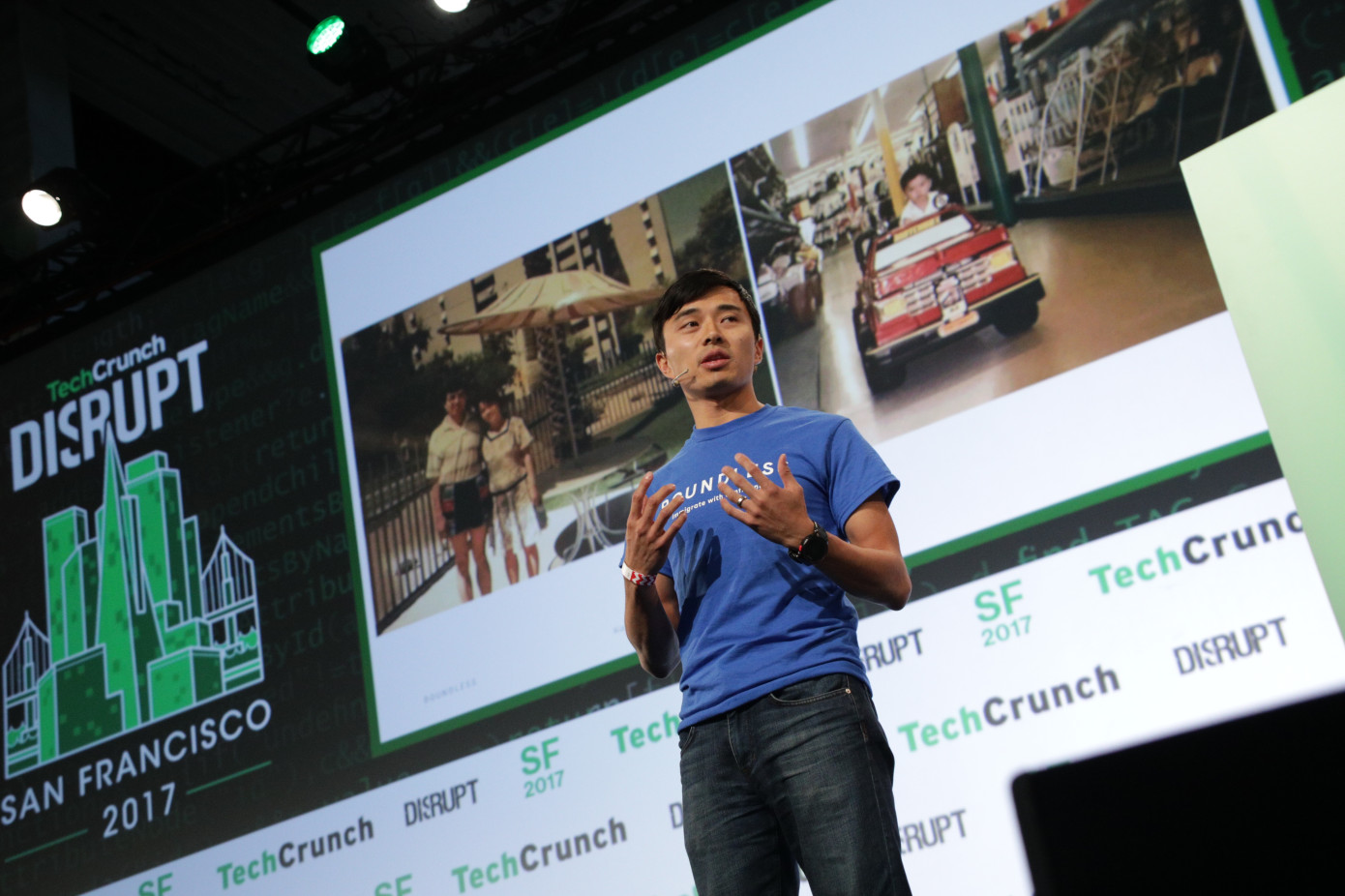
Boundless CEO Xiao Wang at TechCrunch Disrupt 2017

Operating under the startup studio model, PSL’s team of former founders and venture capitalists, including Rover and Mighty AI founder Greg Gottesman, collaborate to craft and incubate startup ideas, then recruit a founding CEO from their network of entrepreneurs to lead the business. Seattle is home to two of the most valuable businesses in the world, but it has not created as many founders as anticipated. PSL hopes that by removing some of the risk, it can encourage prospective founders, like Boundless CEO Xiao Wang, a former senior product manager at Amazon, to build.

“The studio model lends itself really well to people who are 99% there, thinking ‘damn, I want to start a company,’ ” PSL co-founder Ben Gilbert said in March. “These are people that are incredible entrepreneurs but if not for the studio as a catalyst, they may not have [left].”

Boundless is one of several successful PSL spin-outs. The business, which helps families navigate the convoluted green card process, raised a $7.8 million Series A led by Foundry Group earlier this year, with participation from existing investors Trilogy Equity Partners, PSL, Two Sigma Ventures and Founders’ Co-Op.

Years-old institutional funds like Seattle’s Madrona Venture Group have done their part to bolster the Seattle startup community too. Madrona raised a $100 million Acceleration Fund earlier this year, and although it plans to look beyond its backyard for its newest deals, the firm continues to be one of the largest supporters of Pacific Northwest upstarts. Founded in 1995, Madrona’s portfolio includes Amazon, Mighty AI, UiPath, Branch and more.

Voyager Capital, another Seattle-based VC, also raised another $100 million this year to invest in the PNW. Maveron, a venture capital fund co-founded by Starbucks mastermind Howard Schultz, closed on another $180 million to invest in early-stage consumer startups in May. And new efforts like Flying Fish Partners have been busy deploying capital to promising local companies.

There’s a lot more to say about all this. Like the growing role of deep-pocketed angel investors in Seattle have in expanding the startup ecosystem, or the non-local investors, like Silicon Valley’s best, who’ve funneled cash into Seattle’s talent. In short, Seattle deal activity is finally climbing thanks to top talent, new accelerator models and several refueled venture funds. Now we wait to see how the Seattle startup community leverages this growth period and what startups emerge on top.


from Amazon – TechCrunch https://techcrunch.com/2019/12/30/in-the-shadow-of-amazon-and-microsoft-seattle-startups-are-having-a-moment/

Friday, September 27, 2019

TC’s Greg Epstein and Kate Clark talk mental health startups and the ‘Cult of the Founder’

Some weeks, tech ethics is in the news. And some weeks, it IS the news. This week was one of the latter,

There were so many ethically fraught news stories about technology companies over these past few days, I had trouble keeping track of them all. So I’m delighted that my latest interviewee for this series on ethics and technology is TechCrunch’s own Kate Clark, a reporter covering startups and venture capital.

Kate is one of the tech reporters on whom I rely most heavily for insight into what the hell is going on in Silicon Valley, and not just because she’s prolific, a fine writer, and so hardworking she seems to attend every VC dinner and startup product launch in Northern California (though she is all of those things).

I also turn to her (well actually, I turn to her Twitter — we’ve never met in person) because, though she would never claim to have any special training or authority in ethics, she has three of the top qualities I look for in an ethical leader: a passion for equitable inclusion; a well-modulated bullshit detector; and enough compassion for humanity to expect better of us all.

When Kate and I spoke on Wednesday afternoon, she was as harried as you might expect, at least based on her tweets.

image1 1

Image via Twitter / Kate Clark / @KateClarkTweets

Greg Epstein: I’ve been looking forward to talking to you for a while now, and I certainly picked a busy day.

Kate Clark: Not as bad as yesterday.

Epstein: I follow your work closely; it informs mine. I’m sitting here in Cambridge, Massachusetts, where I work, and I’m thinking about the ethics of technology.


from Amazon – TechCrunch https://techcrunch.com/2019/09/27/tcs-greg-epstein-and-kate-clark-talk-mental-health-startups-and-the-cult-of-the-founder/

Wednesday, September 25, 2019

Bodega, once dubbed ‘America’s most hated startup,’ has quietly raised millions

2What’s in a name?

More than two years ago, Fast Company published a story with the headline “Two Ex-Googlers Want To Make Bodegas And Mom-And-Pop Corner Stores Obsolete.” The focus of the story was a nascent startup by the name of Bodega.

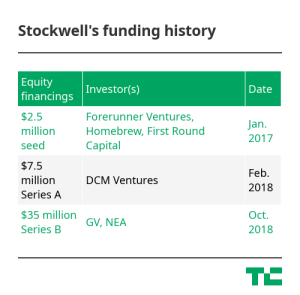
The company had raised $2.5 million in funding from First Round Capital’s Josh Kopelman, Forerunner Ventures’ Kirsten Green and Homebrew’s Hunter Walk. To announce their funding and vision to create the unmanned store of the future, Bodega briefed a number of journalists on its big idea. Given the simplicity of its product — a tech-enabled vending machine, in essence — the team was blindsided by the uproarious response that followed. September 13, 2017 was supposed to be the most exciting day in the startup’s history, at least until that point; instead, it was a nightmarish lesson in poor branding and messaging.

Why do tech wizards keep thinking of new and more horrible ways to avoid dealing with people? -CityLab, September 13, 2017

The press storm and public lambasting catapulted Bodega into the limelight — for all the wrong reasons. Overnight, the company went from just another early-stage commerce business to the symbol of everything that is wrong with Silicon Valley. Many wondered if it would fall victim to criticism and crumble like Juicero, a well-financed startup that sold a $400 juicer — that is, until a Bloomberg story proved its juice packets could be squeezed by hand, no machine necessary. Or would it take the public condemnation in stride, hearing out the critics and amending its brand as necessary?

Two years after its ill-fated launch, the latter seems to be true. Today, the three-year-old Oakland-based company — now known as Stockwell — is said to be growing quickly thanks to more than $45 million in venture capital funding from a number of deep-pocketed investors, the company has confirmed to TechCrunch.

Bodega

Bodega’s original branding included a cat logo. Cats are often features of small neighborhood stores, known as bodegas.

Public outcry

Bodega is either the worst named startup of the year, or the most devious,” wrote The Verge in the fall of 2017. “Tech firm markets glorified vending machines where users can buy groceries,” said The Guardian. The Washington Post dubbed the company “America’s most hated start-up.” CityLab, which writes about issues impacting cities, bluntly reported “Bodega, a Startup for Disrupting Bodegas, Is Terrible,” followed by 30 reasons why the startup sucks: “Maybe a Bodega can stock Soylent to appeal to people who also think that eating delicious food is a grim burden,” CityLab wrote. “Why do tech wizards keep thinking of new and more horrible ways to avoid dealing with people? How come they hate being human?”

It’s safe to say Bodega endured one of the most catastrophic company launches in the history of tech startups. But the press cycle surrounding Bodega was more than an attack on the startup alone. It represented a greater frustration with Silicon Valley culture and its reputation for funding “disruptive” products devoid of impact. Time and time again, VCs had proven their willingness to inject millions into standard concepts lacking originality. A juicer had raised more than $100 million, after all, scooters were beginning to attract private capital and Soylent, which sells a meal replacement drink fit for techies, was hot off the heels of a $50 million round.

A mini-fridge equipped with computer vision technology boasting a culturally insensitive name wasn’t going to change the world. Questioning why it had the support of VCs was only fair.

An innocent misunderstanding?

Behind the upsetting name was a business developing hundreds of five-foot-wide pantry boxes to be housed in luxury apartment lobbies, offices, college campuses, gyms and more. Similar to Amazon Go, the “smart stores” recognize what customers remove from the cases using computer vision and automatically charge the credit card associated with the account.

When you’re not in the room, the name of your company is what gets passed between people. -James Currier, NFX.

Bodega was founded by a pair of Google veterans, Paul McDonald and Ashwath Rajan. It had all the ingredients for a successful startup stew. Founders with years of experience in big tech: McDonald spent more than a decade at Google; Rajan had just finished up the search engine’s competitive associate product manager program. Both attended top universities: University of California-Berkeley and Columbia University, respectively. Still, neither of the two men nor their investors seemed to have predicted the controversy afoot.

“Bodega doesn’t want to disrupt the bodega,” Hunter Walk, a Bodega investor and co-founder of the seed fund Homebrew, wrote in a 2017 blog post. “Some instances of today’s press coverage suggested that element, a sound bite which, exacerbated by Bodega’s naming, pissed people off as another example of tech startups being at best tone-deaf, and at worst, predatory … It didn’t occur to me that some people would see the word and associate its use in this context with whitewashing or cultural appropriation.”

The company, too, quickly authored a blog post outlining their thought process behind the name: “Rather than disrespect to traditional corner stores — or worse yet, a threat — we intended only admiration,” McDonald wrote.

After penning blog posts, the founders continued working on the company under the provocative and upsetting name. Meanwhile, investors seemed unfazed by the negative press, evidenced by the company’s ability to continue raising venture capital funding. After all, many of the best businesses endure the wrath of bloggers, competing founders and the general public. As for VCs, high-risk bets are just part of the ball game.

DCM Ventures, a U.S.-based venture capital fund with offices in Beijing, Tokyo and Silicon Valley, was the first to agree to invest in Bodega following the PR disaster. The firm, an investor in Lime, Hims and SoFi, led a $7.5 million Series A financing in the business in early 2018, the company confirmed. DCM co-founder and general partner David Chao joined the company’s board following the deal. DCM vice president David Cheng is also actively involved with the company, according to his bio.

Finally, after pocketing nearly $10 million in total funding, Bodega announced a name change: “Did you buy something today from a Bodega?” Bodega’s McDonald wrote. “You may have noticed that we’ve changed our name to Stockwell. Our new name is one of the changes we’re making as we expand our offerings and open more stores around the country.”

Stockwell Founders

Stockwell, fka Bodega, founders Paul McDonald (left) and Ashwath Rajan (Courtesy of Stockwell).

A new era

With a new logo and a toned-down, somewhat bland identity, Stockwell had a fresh start and, soon, more attention from top VCs. In late 2018, the company raised a $35 million round of funding co-led by Uber and Slack-backer GV, formerly known as Google Ventures, and NEA, an investor known for bets in Coursera, MasterClass and OpenDoor, Stockwell has confirmed. NEA’s Amit Mukherjee and GV’s John Lyman joined Stockwell’s board as part of the deal, which is said to have valued the business at north of $100 million. Stockwell, however, declined to confirm the figure.

Stockwell's funding history

Instead of announcing the news via TechCrunch, Venture Beat, Forbes or another tech publication, as is the norm for fast-growing consumer-facing startups, Stockwell remained mum on financing events and scaling plans, assumedly burned by the press and the public’s scorn a year prior.

Rather than subject itself to continued scrutiny as it attempted to rewrite its narrative, Stockwell was heads down, iterating, expanding and quietly raising millions. Bad press can break a startup, and given the sheer number of negative reports on Stockwell so early on, the company had already defied the odds. Keeping a low profile was undoubtedly the best strategy moving forward, and it seems to have paid off.

“It was a difficult time and transition and we learned a lot from it,” a spokesperson for Stockwell said in an email to TechCrunch. “As a company, we put our heads down and focused on building our business. We kept a low profile and concentrated on our core product, the mission, and the people who work for us. We’re excited for the progress we’ve made but won’t forget the path that got us here.”

Today the company counts 1,000 “stores” in the San Francisco Bay Area, Los Angeles, Houston and Chicago. Stockwell has used its latest infusion of funding to explore shared ownership models, i.e. the opportunity for anyone to run their own Stockwell store. The company tells TechCrunch they are also working on building out their “unique curation model,” which allows customers to help determine what items are stocked in their local “store,” as well as their support for emerging brands, whose products they can stock in their next-generation vending machines.

Stockwell

Stockwell’s five-foot wide next-generation vending machine.

So what’s in a name?

Human beings make snap judgments, evaluate products quickly and can develop distaste for brands in a matter of seconds. A company’s moniker is their first opportunity to impress customers.

“When you’re not in the room, the name of your company is what gets passed between people,” writes NFX co-founder James Currier. “It speaks for you when you’re not there … It sets expectations of your company in the blink of an eye. And first impressions are hard to change. Both positive and negative.”

Most cases of poor startup naming are easily fixed. Most founders aren’t forced to bear the brunt of the internet’s fury. The case of Bodega is much more extreme and, as such, serves as the ultimate lesson for founders searching for the best way to tell their story. At the end of the day, avoiding a complete and total train-wreck is easy if you include a diverse group of people in the naming process and remember there’s a lot in a name — if that weren’t the case, Bodega would still be Bodega.


from Amazon – TechCrunch https://techcrunch.com/2019/09/25/bodega-once-dubbed-americas-most-hated-startup-has-quietly-raised-millions/

Your guide to WeWork’s CEO shuffle

Hello and welcome back to Equity, TechCrunch’s venture capital-focused podcast, where we unpack the numbers behind the headlines.

This week Kate and Alex were back at TechCrunch’s San Francisco HQ to huddle over the weeks’ biggest news story: WeWork’s infamous CEO exiting his role. Adam Neumann is now merely the non-executive chairman of The We Company, a firm that he helped found and led the public story for over the last half-decade.

His exit comes after a number of revelations made his tenure at the highly-valued WeWork appear chaotic and self-dealing. After WeWork’s valuation tumbled as it raced towards a financially-critical IPO, something had to give. The firm tried to ameliorate investors with changes (read: improvements) to its corporate governance but that wasn’t enough. Snakes don’t rot from the tail, and WeWork needed new leadership, which it got the form of co-CEOs.

WeWork is now led by Sebastian Gunningham and Artie Minson, seasoned executives with stints at Amazon and Time Warner Cable, respectively. They’ve been charged with leading the company into an era of maturity, cost-cutting and maybe even profitability! But probably not. Anyway, we think there are a whole lot of parallels to draw between Uber and WeWork, as we’ve made clear in the past.

Kate and Alex also touched on corporate governance, especially regarding super-voting stock. The TL;DR: private company boards look and operate much differently than public company boards. More often than not, startup boards are made up of venture capitalists focused on protecting their equity and future returns. It’s a dog-eat-dog world, folks.

Wapping, it seems likely that WeWork will look to secure new cash in the short-term as it buttons up its business, divests or kills off non-performing assets (remember this?), and looks to temper both its growth-rate and losses. If that will be enough to allow the company to float in 2020 (2019 seems unlikely) isn’t clear.

Icarus.

We’re back Friday morning with our regular episode and a guest. Stay tuned!

Equity drops every Friday at 6:00 am PT, so subscribe to us on Apple PodcastsOvercastSpotify, and all the casts.


from Amazon – TechCrunch https://techcrunch.com/2019/09/25/your-guide-to-weworks-ceo-shuffle/

Saturday, August 31, 2019

Startups Weekly: Peloton’s 29 secret weapons

Hello and welcome back to Startups Weekly, a weekend newsletter that dives into the week’s noteworthy startups and venture capital news. Before I jump into today’s topic, let’s catch up a bit. Last week, I wrote about a new e-commerce startup, Pietra. Before that, I wrote about the flurry of IPO filings.

Remember, you can send me tips, suggestions and feedback to kate.clark@techcrunch.com or on Twitter @KateClarkTweets. If you don’t subscribe to Startups Weekly yet, you can do that here.

What’s new?

Peloton revealed its S-1 this week, taking a big step toward an IPO expected later this year. The filing was packed with interesting tidbits, including that the company, which manufacturers internet-connected stationary bikes and sells an affiliated subscription to its growing library of on-demand fitness content, is raking in more than $900 million in annual revenue. Sure, it’s not profitable, and it’s losing an increasing amount of money to sales and marketing efforts, but for a company that many people wrote off from the very beginning, it’s an impressive feat.

Despite being a hardware, media, interactive software, product design, social connection, apparel and logistics company, according to its S-1, the future of Peloton relies on its talent. Not the employees developing the bikes and software but the 29 instructors teaching its digital fitness courses. Ally Love, Alex Toussaint and the 27 other teachers have developed cult followings, fans who will happily pay Peloton’s steep $39 per month content subscription to get their daily dose of Ben or Christine.

“To create Peloton, we needed to build what we believed to be the best indoor bike on the market, recruit the best instructors in the world, and engineer a state-of-the-art software platform to tie it all together,” founder and CEO John Foley writes in the IPO prospectus. “Against prevailing conventional wisdom, and despite countless investor conference rooms full of very smart skeptics, we were determined for Peloton to build a vertically integrated platform to deliver a seamless end-to-end experience as physically rewarding and addictive as attending a live, in-studio class.”

Peloton succeeded in poaching the best of the best. The question is, can they keep them? Will competition in the fast-growing fitness technology sector swoop in and scoop Peloton’s stars?

In other news

Last week I published a long feature on the state of seed investing in the Bay Area. The TL;DR? Mega-funds are increasingly battling seed-stage investors for access to the hottest companies. As a result, seed investors are getting a little more creative about how they source deals. It’s a dog-eat-dog world out there, and everyone wants a stake in The Next Big Thing. Read the story here.

Rounds of the week

DISRUPT SF 530X350 V1 1

Time to Disrupt

Don’t miss out on our flagship Disrupt, which takes place October 2-4. It’s the quintessential tech conference for anyone focused on early-stage startups. Join more than 10,000 attendees — including over 1,200 exhibiting startups — for three jam-packed days of programming. We’re talking four different stages with interactive workshops, Q&A sessions and interviews with some of the industry’s top tech titans, founders, investors, movers and shakers. Check out our list of speakers and the Disrupt agenda. I will be there interviewing a bunch of tech leaders, including Bastian Lehmann and Charles Hudson. Buy tickets here.

Listen

This week on Equity, TechCrunch’s venture capital-focused podcast, we had Floodgate’s Iris Choi on to discuss Peloton’s upcoming IPO. You can listen to it here. Equity drops every Friday at 6:00 am PT, so subscribe to us on Apple PodcastsOvercast and Spotify.

Learn

We published a number of new deep dives on Extra Crunch, our paid subscription product, this week. Here’s a quick look at the top stories:


from Amazon – TechCrunch https://techcrunch.com/2019/08/31/startups-weekly-peloton-ipo/

Tuesday, July 30, 2019

NakedPoppy launches curated beauty marketplace for wellness junkies

NakedPoppy co-founders Jaleh Bisharat and Kimberly Shenk are an impressive duo. Bisharat, the startup’s chief executive officer, is a commanding presence and a bona fide marketing savant. The perfect compliment to Shenk, a reticent and data-focused chief product officer.

Together they’re building a cosmetics startup, NakedPoppy, where people can purchase high-quality “clean” makeup, or sustainable, ethically-made and cruelty-free products produced without harmful chemicals. It launches today with $4 million in venture capital backing from top investors, including Cowboy Ventures (the seed-stage fund led by Aileen Lee), Felicis Ventures, Khosla Ventures, Maveron, Polaris Ventures and Slow Ventures.

“Conventional makeup is considered hazardous waste by the EPA,” Bisharat tells TechCrunch. “You can look better and go clean.”

But NakedPoppy isn’t just another website for buying makeup. Like all companies today, it’s a tech company. NakedPoppy’s patent-pending personalization algorithm helps customers quickly find makeup that matches or complements their skin tone. To do this, customers are asked to complete a three-minute assessment and submit a photo of their wrist, which is used to pinpoint their base skin color.

NakedPoppy assessment

“I’m not the person that is up to trends or is keeping up with the YouTube stars,”  NakedPoppy’s product chief Shenk tells TechCrunch. “When I walk into Sephora my stomach drops … I am the kind of woman that wants to set it and forget it. Just give me the right thing and let’s move on.”

Bisharat adds that NakedPoppy targets the busy woman: “The one for whom it’s not entertainment to go shopping for makeup.”

The NakedPoppy team hopes its algorithm expedites the makeup shopping process for those who view the task as a chore not a hobby. Accounting for skin type, skin color, skin undertone, age, eye color, hair color, allergies, sensitivities and more, the startup presents each customer a filtered and tailored list of the 400 items its carries, ranging from lipsticks to foundation to blush and more. Cosmetic chemists screen all NakedPoppy products to ensure they were made with only clean ingredients.

Alongside its official launch, NakedPoppy is announcing its debut original product: Liquid eyeliner. The product was screened and tested by a number of clean beauty experts and even a VC: “This is a hero product, no doubt about it,” BBG Ventures’ managing partner Susan Lyne said in a statement. Lyne, of course, is a NakedPoppy angel investor. “Most eyeliners start drying out after a few weeks and get harder to apply. This one is still as supple as the day I got it. It looks natural, lasts all day and washes off easily with soap. It’s pretty perfect.”

For the record, I tried out the NakedPoppy eyeliner too and can attest to its greatness.

NakedPoppy founders

NakedPoppy co-founders Jaleh Bisharat (CEO, left) and Kimberly Shenk (CPO, right).

The women behind NakedPoppy, as I alluded to earlier, know what they’re doing. In fact, I’d go as far as to say they could’ve paired their marketing and data science expertise to build just about anything. Makeup, however, was their shared passion.

“For us, it’s a personal passion and an area of information asymmetry, like most people know that with the food you eat, you should try to eat organic or as healthy as you can, but you’d be surprised how few women — they just assume the FDA protects them,” Bisharat said. “The idea is to educate the world and help women move toward new solutions.”

Bisharat got her start in marketing two decades ago. Shortly after the e-commerce giant went public, she served as the vice president of marketing at Amazon. A career peak for many, Bisharat went on to lead marketing efforts at OpenTable, Jawbone, UpWork and, most recently, Eventbrite, where she met Shenk.

Before moving into the private sector, Shenk got her start as a data scientist in the U.S. Air Force, ultimately ending up as the director of data science at the now-public ticketing and events business, Eventbrite.

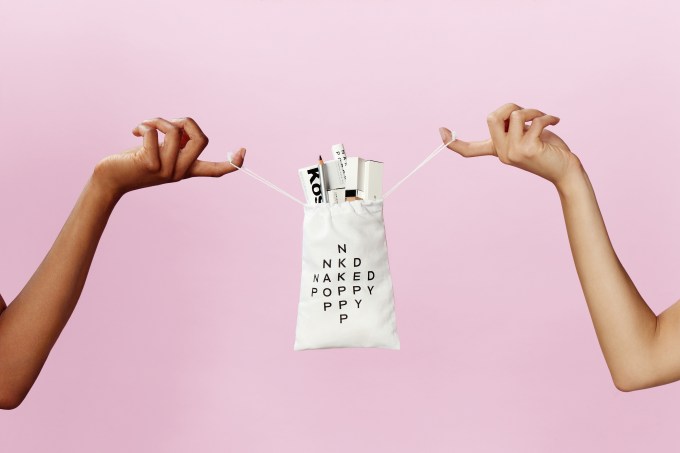
10 NakedPoppy Pouch

Bisharat and Shenk remained mum on what marketing tactics they’ll deploy to capture the attention of potential customers. Will they partner with social media influencers to spread the word? Double down on Instagram ads? Open brick-and-mortar shops? They wouldn’t say. Additional original products are definitely in the works, though, as is a foray into skincare and ultimately, a full-fledged dive into all self-care products.

The hope is to making buying clean makeup easy. Historically, the big makeup brands have been owned and operated by one of a dozen or so large companies dominating the space. Increasingly, however, direct-to-consumer brands and startups, most notably Glossier, have attracted customers that prioritize ease-of-access.

As the beauty industry adjusts, an influx of digital-first upstarts, NakedPoppy included, will be poised to steal market share from the long-reigning giants. Perhaps NakedPoppy’s push toward transparency in ingredients and production will encourage the big brands to do the same.


from Amazon – TechCrunch https://techcrunch.com/2019/07/30/nakedpoppy/

Thursday, July 25, 2019

Standard Cognition lands $35M at $535M valuation to battle Amazon Go

EQT Ventures, Initialized Capital, CRV and Y Combinator have fueled Standard Cognition with another $35 million to help retailers battle Amazon. The deal values the San Francisco-based autonomous checkout startup, founded in 2017, at $535 million.

Standard Cognition implants its AI-powered computer vision platform, which enables the autonomous checkout process, in brick-and-mortar stores. To date, the company has installed its hardware in five stores in the U.S. and Japan, with plans to expand globally using the new investment. Standard Cognition co-founder and chief operating officer Michael Suswal tells TechCrunch the company is counting on support from European VC firm EQT Ventures, which led the deal, to launch its technology in Europe.

Here’s a breakdown of the Standard Cognition autonomous checkout experience: A customer walks into one of Standard Cognition’s partners’ stores and one of 27 overhead cameras (more or less depending on the size of the store) will identify you by shape and movement, not facial recognition. The customer then opens the company’s iOS or Android app and a special light pattern flashes, allowing the cameras to tie you to your account and payment method. Finally, grab whatever items you need and leave the store. No checkout is required for Standard Cognition to bill you. It even works without an app: Shop like normal and then walk up to a kiosk screen, the cameras identify what items you have chosen and you can pay with cash or credit card.

News of Standard Cognition’s Series B comes shortly after Amazon confirmed plans to open three additional Amazon Go stores, the e-commerce giant’s cashierless convenience stores. Amazon opened its first Amazon Go store in Seattle in 2016, though Standard Cognition, which operates only one branded brick-and-mortar store of its own, was first to plant roots in San Francisco. Standard Cognition, however, has no plans to open any more of its own stores because “running stores takes a lot of effort,” said Suswal. Instead, the company plans to bring its cashierless experience to other retail chains with the fresh funds.

Standard Cognition announces its Series B financing just eight months after closing a $40 million Series A. Suswal, justifying the lightning-fast growth, said 2019 has been Standard’s “year of deployment,” next year will be “the year of repeatability” and 2021 will be “the year of scale.” The company has raised a total of $86 million in venture capital funding.

“Traditional brick and mortar retailers are caught in a perfect storm,” EQT partner Alastair Mitchell said in a statement. “From the encroachment of behemoths like Amazon into every inch of the market to changing consumer attitudes, as busy people demand an ever more efficient shopping experience, margins are being squeezed like never before. The talented and driven Standard Cognition team have worked quickly to build a product that allows physical retailers, of all sizes, to tackle these challenges.”


from Amazon – TechCrunch https://techcrunch.com/2019/07/25/standard-cognition-lands-35m-at-535m-valuation-to-battle-amazon-go/

Wednesday, May 15, 2019

Madrona Venture Labs raises $11M to build companies from the ground up

In regions where would-be entrepreneurs need a little more support and encouragement before they’ll quit their day job, the startup studio model is taking off.

In Seattle, one of its oldest and most-celebrated venture capital firms, Madrona Venture Group, has raised $11.3 million for its studio, Madrona Venture Labs (MVL). The investment brings the studio’s total funding to $20 million.

Traditional venture capital funds invite founders to pitch their business idea to a line-up of partners. Sometimes that’s a founder with an idea looking for seed capital, other times it’s a more mature company looking to scale. When it comes to startup studios, the partners themselves craft startup ideas internally, recruiting entrepreneurs to lead the projects, then building them from the ground up within their own safe, protective walls. After a project passes the studio’s litmus test, i.e. shows proof of traction, product-market fit and more, it’s spun out with funding from Madrona and other VCs within its large and growing investor network.

For aspiring entrepreneurs deterred by the risk factors inherent to building venture-backed startups, it’s a highly desirable route. In the Pacific Northwest, where MVL focuses its efforts, it’s a chance to lure Microsoft and Amazon employees into the world of entrepreneurship.

“We want to be an onboard for founders in our market,” MVL managing director Mike Fridgen, who previously founded the eBay-acquired business Decide.com, tells TechCrunch. “In Seattle, everyone isn’t a co-founder or an angel investor. Not everyone has been at a startup. A lot of people coming here are coming to work at Amazon, Microsoft or one of the larger satellite offices like Facebook. We want to help them fast-track learning, fundraising and everything else that comes with launching a successful company.”

Fridgen, MVL managing director Ben Elowitz, who co-founded the online jewelry marketplace Blue Nile and chief technology officer Jay Bartot, the co-founder of Hulu-acquired Vhoto, lead Madrona’s studio effort.

The investment in MVL comes in part from its parent company, Madrona, and for the first time, outside investors have acquired stakes in the practice. Alpha Edison, West River Group, Founder’s Co-op partner Rudy Gadre, Zillow co-founder Spencer Rascoff, former GoDaddy CEO Blake Irving, Trinity Ventures venture partner Gus Tai, TCV venture partner Erik Blachford and others participated.

With $1.6 billion in assets under management, Madrona is known for investments in Seattle bigwigs like Smartsheet, Rover and Redfin. The firm, which recently closed on another $100 million for an acceleration fund that will expand its geographic reach beyond the Pacific Northwest, launched its startup studio in 2014. Since then, it’s spun-out seven companies with an aggregate valuation of $140 million.

“There are some 85 VCs that have $300 million-plus funds,” Fridgen said. “In Seattle, we have two of the most valuable companies in the world and we have just one [big fund], Madrona; it’s the center of gravity for Seattle technology innovation.”

Companies created within MVL include Spruce Up, an AI-powered personal shopping platform, and Domicile, a luxury apartment rental service geared toward business travelers. Domicile was co-founded by Ross Saario, who spent the three years ahead of launching the startup as a general manager at Amazon. The company recently raised a $5 million round, while Spruce Up, co-founded by serial founder Mia Lewin, closed a $3 million round in May.

Other spin-outs include MightyAI, which was valued at $71 million in 2017; Nordstrom-acquired MessageYes, Chatitive and Rep the Squad. The latter, a jersey rental business, was a failure, shutting down in 2018 after failing to land necessary investment, according to GeekWire.

MVL’s latest fundraise will be used to invest in operations. Though MVL does provide its spin-outs with some capital, between $100,000 to $200,000 Fridgen said, it takes a back seat when it comes time to raise outside capital and doesn’t serve as the lead investor in deals.


from Amazon – TechCrunch https://techcrunch.com/2019/05/15/madrona-venture-labs-raises-11m/

Saturday, May 4, 2019

Startups Weekly: Will the Seattle tech scene ever reach its full potential?

Greetings from Seattle, the land of Amazon, Microsoft, two of the world’s richest men and some startups.

I’m always surprised the Seattle startup ecosystem hasn’t grown to compete with the likes of Silicon Valley — or at least Boston and New York City — since the dot-com boom. Today, it’s the strongest it’s has been due to the successes of companies like the newly minted unicorn Outreach, trucking business Convoy and, of course, the dog walking startup Rover. But the city still lags behind, failing to adopt the culture of entrepreneurship that defines San Francisco.

I spent a lot of time wondering why it hasn’t reached its full potential. Is it because Microsoft and Amazon pay their employees so well they don’t have the same urge to build something from the ground up? Is it a lack of access to capital? Is the city not attracting top talent? If you have thoughts, send them my way.

“We think part of the issue is a lack of capital and a lack of help,” Rover and Pioneer Square Labs co-founder Greg Gottesman told TechCrunch earlier this year. “If we can provide a little bit of both of those things, we can really put Seattle where it deserves to be, should be and will be.”

Despite its shortcomings, there is still some action in the city I want to highlight this week. A same-day delivery business, Dolly, is on the rise. The startup told me on Thursday it had raised a $7.5 million round from Unlock Venture Partners, Maveron and Jeff Wilke, the chief executive officer of Amazon Worldwide Consumer. Maveron, if you remember, is the VC fund co-founded by Starbucks founder Howard Schultz.

In other Seattle news, Madrona Venture Group, a well-regarded fund, raised an additional $100 million this week. Typically, Madrona focuses on companies based in the Pacific Northwest, but this fund will deploy capital throughout the entire U.S. Hmmm, that’s not necessarily a good sign for Seattle founders, but great progress for the ecosystem nonetheless.

If you’re interested in learning more about Seattle tech, I’ve covered it a bit because it’s my hometown! Start with this story, which dives deep into a Seattle accelerator that’s working hard to encourage entrepreneurship in the city. Alright, on to other news.

Want more TechCrunch newsletters? Sign up here.

IPO corner!

WeWork: The co-working giant now known as The We Company submitted confidential IPO documents to the SEC, the company confirmed in a press release Monday. Is this the next massive startup win or a house of cards waiting to be toppled by the glare of the public markets? TechCrunch’s Danny Crichton investigates.

Slack: The business is in its final steps toward a much-anticipated direct listing, with one source telling TechCrunch the listing will be complete within 45 days. The WSJ reported this week that Slack will make an online presentation to potential shareholders on May 13. This week, we dug deep into Slack’s S-1 and decided to evaluate just how well the tech press, us included, did in covering the company. For the most part, the tech press did decently well, except for one curious, $162 million gap.

Uber: Finally! That ride-hailing company is going public next week. That latest news? Uber co-founder Travis Kalanick won’t be ringing the opening bell. Uber would not be where it is today without Kalanick, but him being there would surely be a reminder of Uber’s rocky past.

Beyond Meat: Shares of the company surged up 135 percent in their market opener last week, valuing the company as high as $3.52 billion. Volatility was so high on the company’s stock that the Nasdaq had to pause trading of “BYND” shares.

Micro-mobility instability:

Ofo has run into its fair share of issues, laying off hundreds of workers, shutting down its international division and more. Now, you can buy a piece of the startup’s history.

In other micro-mobility news, Lyft’s head of scooter & bikes Liam O’Connor, who was hired to help transportation company Lyft build its bike and scooter operations, has left after seven months with the newly-public company. TechCrunch’s Ingrid Lunden has the scoop. Plus, Bird, the electric scooter unicorn doing its best to overcome regulatory barriers, has made its way back to San Francisco. Bird is using its business license in San Francisco to introduce monthly personal rentals in the city. The program enables people to rent a scooter for $24.99 a month with no cap on the number of rides. We’ll how that goes.

WTF?

For some reason, people are giving Magic Leap more money. The company has secured another $280 million in a deal with Japan’s largest mobile operator, Docomo. Do you know what that means? The developer fo AR/VR headsets has raised a total of $2.6 billion. We’re just as confused as you.

Brand new venture capital funds:

Unshackled Ventures raised $20 million. 

Jungle Ventures closed on $175 million.

And Toyota AI Ventures launched a $100 million fund.

Startup Capital

Uber investors exit

I have the inside story on Menlo Ventures early Uber stake and TechCrunch’s Connie Loizos goes deep with early Uber backer Bradley Tusk.

Extra Crunch!

This week, we offer TechCrunch Extra Crunch subscribers exclusive tips on building extraordinary teams. Plus, the final piece in TechCrunch’s Greg Kumparak’s series on Niantic, the fast-growing developer of Pokemon Go. If you recall, we’ve captured much of Niantic’s ongoing story in the first three parts of our EC-1, from its beginnings as an “entrepreneurial lab” within Google, to its spin-out as an independent company and the launch of Pokémon GO, to its ongoing focus on becoming a platform for others to build augmented reality products upon.

If you enjoy this newsletter, be sure to check out TechCrunch’s venture-focused podcast, Equity. In this week’s episode, available here, Crunchbase News editor-in-chief Alex Wilhelm and TechCrunch’s Danny Crichton chat about updates at the Vision Fund, Cheddar’s big exit and more of this week’s headlines.


from Amazon – TechCrunch https://techcrunch.com/2019/05/04/startups-weekly-will-the-seattle-tech-scene-ever-reach-its-full-potential/

Monday, April 8, 2019

Human rights activist Amira Yahyaoui is battling the US college financial aid system

Tunisian human rights activist Amira Yahyaoui couldn’t go to college.

Not because she couldn’t afford it; where she comes from, college is virtually free. She lost the opportunity to pursue higher education, to finish high school, even, when she was exiled from Tunisia at age 17, under the repressive regime of the country’s former President, Zine El Abidine Ben Ali.

As part of the Tunisian human rights diaspora, she was inspired to build Al Bawsala, a globally renowned NGO that fights for government accountability, transparency and access to information. Now, Yahyaoui has traveled thousands of miles to San Francisco to fight another battle near and dear to her heart: civic education, or in Silicon Valley terms, edtech.

“I always knew that I wouldn’t allow myself to do anything else before solving the problem in my country and today, Tunisia is the only Arab democracy in the world,” Yahyaoui told TechCrunch.

With that in mind, her focus has shifted to Mos, a tech-enabled platform for students to apply for financial aid. With backing from Uber co-founder Garrett Camp, his startup studio Expa, Kleiner Perkins chairman John Doerr, Base Ventures, Sweet Capital and others, Mos has closed a $4 million seed round and plans to take its recently-launched product to the next level.

The startup seeks to decrease American student debt, which totaled nearly $1.6 trillion in 2018, and digitize the antiquated government systems that deter students from applying for financial aid. For a one-time fee of $149 and about 20 minutes of their time, Mos helps students of all backgrounds maximize their aid awards.

“Our mission is to bridge the gap between citizens and government in a way that works with technology today,” Yahyaoui said.

Yahyaoui is applying what she’s learned building a government-fighting NGO to the startup world, and with the support of top-tier investors, she’s well on her way to proving an “uneducated” immigrant woman of color can write a Silicon Valley success story for the masses.

A face of the Arab Spring
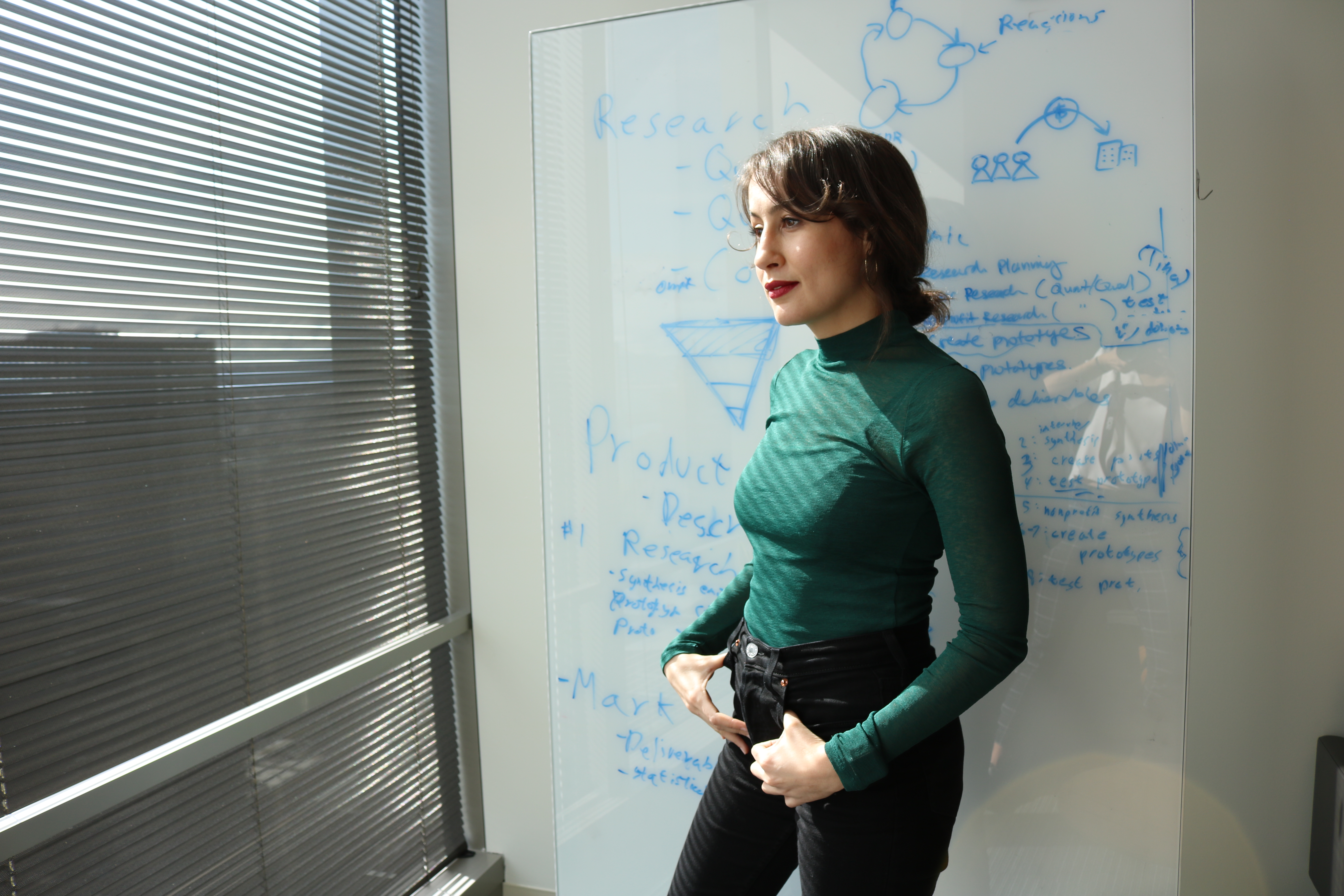
Mos founder and chief executive officer Amira Yahyaoui.

After being forced out of her home country, Yahyaoui fled to France, where she lived as an illegal immigrant and continued to fight against Tunisia’s authoritarian leadership through her blog and an anti-censorship campaign she started online.

When social media sparked anti-government protests across the Middle East, Yahyaoui, still unable to reenter Tunisia, became a face of what was later called the Arab Spring. Her digital prowess, activist reputation and persistent efforts to highlight the Tunisian administration’s human rights abuses quickly made her a face of the movement.

On January 14, 2011, when the protests succeeded in making Tunisia a pioneer of Arab democracy and ended Ben Ali’s reign, Yahyaoi got her passport back and went home, immediately.

Back in Tunisia with newfound freedom, she had an agenda: To hold the governing agency charged with writing a new Tunisian constitution accountable.

Yahyaoui built Al Bawsala, translated as The Compass, an NGO focused on transparency and government accountability. Al Bawsala became one of the largest NGOs in the Middle East, a bona fide success that attracted numerous awards and cemented Yahyaoui’s status as a fearless advocate for human rights, a freedom fighter and one of the most influential Arab women in the world.

“I had to work probably 10 times harder to get to be the self-educated me I am today,” she said. “I saw way too many people getting their education refused and therefore their future ruined.”

Her global standing earned her a seat on the board of the United Nation’s High Commissioner For Refugees Advisory Group on Gender, Forced Displacement, and Protection, as well as the title of Young Global Leader at the World Economic Forum and co-chair of the Davos Conference in 2016, a title she shard with Microsoft’s Satya Nadella and GM’s Mary Barra.

Three years later, with a resume enviable to any dignitary, Yahyaoui is leveraging her unique experience to lure in venture capitalists and use their cash for good.

Repairing a broken financial aid system
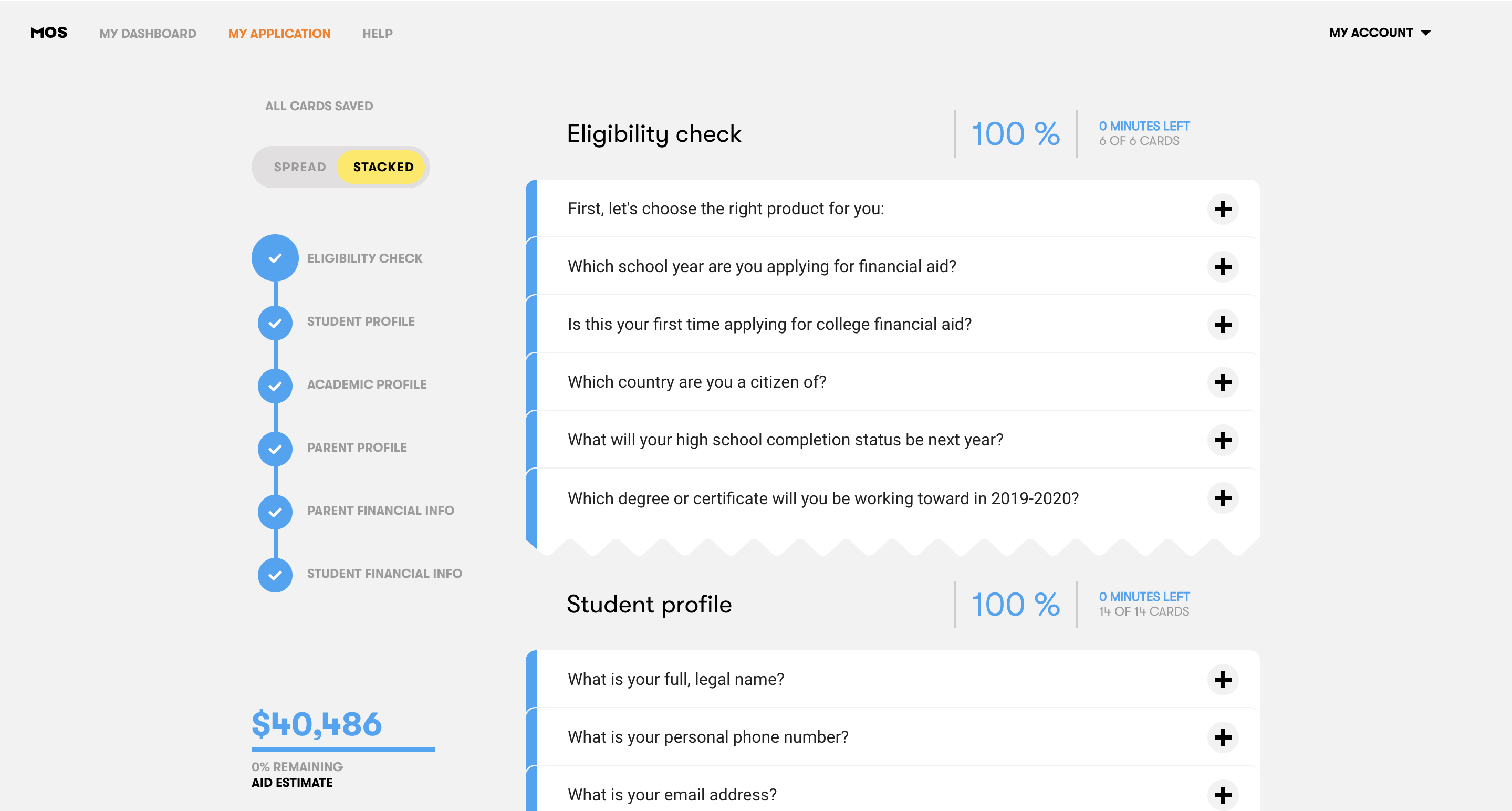
The Mos dashboard.

Mos is like if Turbo Tax married Typeform and had a baby, Yahyaoui explained. Not dissimilar to Common App, Mos lets students apply to more than 500 federal and state-based aid programs in minutes using a survey that matches them to every grant and scholarship program they qualify for, while simultaneously completing the FAFSA and state aid applications. To ensure every family is getting the most financial support possible, a Mos financial aid advisor reviews each case and negotiates with colleges for higher awards.

“Today, the biggest problem is people think they are not eligible for financial aid just because of how the thing is designed,” Yahyaoui said. “You’re supposed to just go ahead and fill a form that has 200 questions and then send it like a bottle in the sea and wait for months.”

Mos will complete a full-scale launch this summer and eventually tackle other nation’s college financial aid systems thanks to the new infusion of capital and the high-profile relationships Yahyaoui has forged in just one year living in the Bay Area.

Ultimately, it was Yahyaoui’s activism that granted her a ticket into the opaque world of Silicon Valley VC. As it turns out, angel investor Khaled Helioui, a fellow Tunisian immigrant who’d taken up residence in San Francisco, was familiar with Yahyaoui’s work and when he heard she had relocated to the Bay Area to launch a technology startup, he wanted to know exactly what she was building. Today, he’s a Mos investor and board member and it was his introductions that helped Yahyaoui quickly and skillfully close her seed round.

An early angel investor in Uber, Helioui connected Yahyaoui with his friend Garrett Camp, the very wealthy co-founder and chairman of the ride-hailing giant, who was sold on Mos’s mission right off the bat.

“I think because Garrett is an immigrant, he knows what it is to suffer with bureaucracy,” Yahyaoui said. “He was a huge believer. He actually made it so easy for me because he said, okay, here’s an office, just stay and work.”

She was then introduced to John Doerr, the chairman of the esteemed VC firm Kleiner Perkins, known for his successful bets on companies like Google and Amazon. With Camp and Doerr on board, Mos didn’t struggle to raise additional capital; in fact, Yahyaoui was in an unusual position of being able to reject investors whose values and vision for Mos clearly didn’t align with hers.

Tearing down barriers

Yahyaoui, center, with the Mos team in San Francisco.

Yahyaoui isn’t in the startup business to get rich off students trying to navigate their way through the absorbently expensive process of applying to and attending college. She’s part of a growing class of founders out to prove that you can pair profits with good morals and lead venture-backed values-based businesses.

“I know if I created the same thing as an NGO, I could have already raised $100 million, but I like the accountability of business,” she said. “We can create businesses that are good for people.”

Yahyaoui’s story, from being exiled from her home country at a young age to fighting an authoritarian regime is not one that’s ever been told before in Silicon Valley.

In addition to being a trailblazing human rights advocate, she’s a woman, an immigrant, “uneducated” by Silicon Valley standards and a first-time tech founder that was able to walk into a meeting with John Doerr and walk out with a term sheet.

If she’s successful in building a global edtech business, she’ll be emblematic of the meritocratic culture The Valley has falsely claimed to uphold. Even if she’s not successful, she’ll have torn down barriers for other underrepresented founders and written a success story fitting for this new era of accountability in tech.


from Amazon – TechCrunch https://techcrunch.com/2019/04/08/human-rights-activist-amira-yahyaoui-is-battling-the-us-college-financial-aid-system/