Thursday, May 2, 2019

Africa Roundup: Jumia’s IPO, DHL launches Africa e-Shop, Cathay’s $168M VC fund, ConnectMed acquired

The biggest news in a month of weighty African headlines was Jumia listing on the New York Stock Exchange.

After filing SEC IPO docs in March, the Pan-African e-commerce company’s shares began trading on the NYSE April 12, opening at $14.50 under ticker symbol JMIA. Jumia stock rose north of 70 percent on its first day of trading and started this week at $46.

With the public listing, Jumia became the first startup from Africa to list on a major global exchange. The IPO raised nearly $200 million for the internet venture.

The listing created another milestone for Jumia.  In 2016 the company became the first African startup unicorn, achieving a $1 billion valuation after a funding round that included Goldman Sachs and MTN.

Founded in Lagos in 2012 with Rocket Internet backing, Jumia now operates multiple online verticals in 14 African countries—from consumer retail to travel bookings.

Jumia has also opened itself up to Africa’s traders with more than 80,000 active sellers on the platform.

Like Amazon, Jumia brings its own mix of supporters and critics. On the critical side, there are questions of whether it’s actually an African startup. The parent for Jumia Group is incorporated in Germany and current CEOs Jeremy Hodara and Sacha Poignonnec are French.

On the flipside, original Jumia co-founders (Tunde Kehinde and Raphael Afaedor) are Nigerian. The company is headquartered in Africa (Lagos) and incorporated in each country in which it operates (under ECART Internet Services in Nigeria). Jumia pays taxes on the continent, employs 5,128 people in Africa (page 125 of K-1) and the CEO of its largest country operation Juliet Anammah is Nigerian.

The Jumia authenticity and diversity debates will no doubt continue. But the biggest question — the driver behind the VC, the IPO, and demand for Jumia’s shares — is whether the startup can produce profits. The company has generated years of losses, including negative EBITDA of €172 million in 2018 compared to revenues of €139 that same year.

DHL Africa e-Shop

Call it coincidence or competition, but the day before Jumia’s IPO, DHL partnered with another e-commerce startup—MallforAfrica.com—to launch its DHL Africa eShop app for global retailers to sell goods to Africa’s consumers markets.

The platform brings more than 200 U.S. and U.K. retailers — from Neiman Marcus to Carters — online in 11 African countries.

DHL Africa eShop operates using startup MallforAfrica.com’s white label service, Link Commerce.

The new online platform takes advantage of the shipping giant’s existing delivery structure on the continent to get goods to doorsteps near and far.

DHL’s partner for the new app, MallforAfrica, was founded in 2011 to solve challenges global consumer goods companies face when entering Africa.

On a B2C level, DHL Africa eShop brings distinct advantages on a transaction cost basis (i.e. the cost of delivery) given it is connected to one of the world’s logistics masters, DHL.

Another component of DHL and MallforAfrica’s partnership is the market for offering e-commerce fulfillment services through MallforAfrica’s white label Link Commerce service.

This could put the duo on a footing to compete with (or work with) big e-commerce names entering Africa and adds another layer of competition with Jumia, which offers its own fulfillment services vertical in Africa.

Cathay Africinvest Innovation Fund

There’s a new $100 million plus African VC fund in the works. Tunisia-based private equity firm Africinvest teamed up with Cathay Innovation to announce the Cathay Africinvest Innovation Fund, with a target raise of $168 million.

Details are still forthcoming, but the fund will focus primarily on Series A to C-stage investments in startups across several countries in the areas of fintech, logistics, AI, agtech and edutech. Investments could begin as early as 2019, fund co-founder Denis Barrier told TechCrunch.

He expects to see strong local showing for startups from across Africinvest’s 10 country offices in North and Sub-Saharan African. The firm will open an office in Johannesburg in the near future, according to a company release.

Zipline expands in Ghana

Zipline, the San Francisco-based UAV manufacturer and logistics services provider, launched a program in Ghana for drone delivery of medical supplies.

Working with the Ghanaian government, Zipline will operate 30 drones out of four distribution centers to distribute vaccines, blood and life-saving medications to 2,000 health facilities across the West African nation daily. Speaking to TechCrunch, the company’s CEO Keller Rinaudo described the Ghana operation as “the largest drone delivery network on the planet,”

The Ghana program adds a second country to Zipline’s live operations. Zipline got off the ground in Rwanda and has leveraged its experience in East Africa to begin testing medical delivery services in the United States. Zipline plans to move from pilot-phase to live-delivery of medical supplies in the U.S. sometime this summer.

ConnectMed acquired by Merck

And finally, German pharmaceutical company Merck KGaa acquired the technology of Kenya based online healthtech company ConnectMed. A 2017 Startup Battlefield Africa competitor, ConnectMed paired up telehealth kiosks to local pharmacies—turning them into online clinics where patients use the startup’s tablet based app to connect live to doctors for evaluation and prescriptions. The startup had received grant and seed funds from UK based Entrepreneur First and Norway’s Katapult Accelerator.
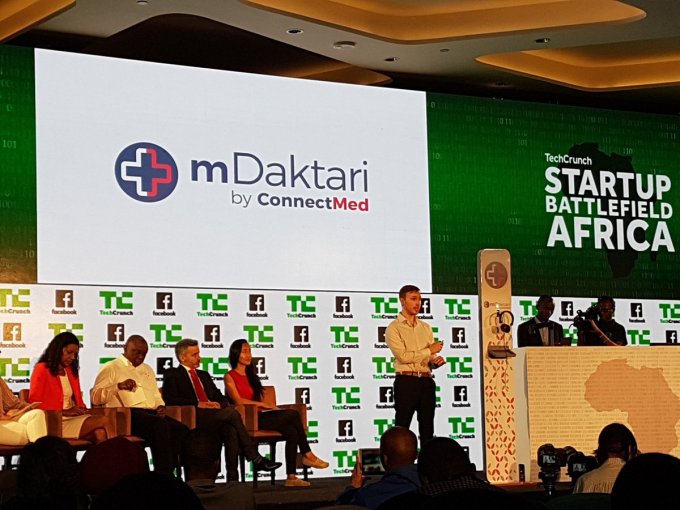
Merck KGaa (not be confused with U.S. pharmaceutical company Merck) took over ConnectMed’s telehealth applications. “Following the handover of the company’s telehealth solutions to Merck…ConnectMed will cease operations,” said a company release on the deal. Merck will integrate ConnectMed’s platform into its own CURAFA clinic network in Kenya.

More Africa Related Stories @TechCrunch

African Tech Around The Net


from Amazon – TechCrunch https://techcrunch.com/2019/05/02/africa-roundup-jumias-ipo-dhl-launches-africa-e-shop-cathays-168m-vc-fund-connectmed-acquired/

The minimizing coin

If your habit is to clear your throat, apologize a few times, minimize the quality of the work you’re about to share and in general, apologize for the assertions you’re about to make…

you probably realize that this is not an effective way to give a talk, lead a class or have a strategic discussion.

Consider carrying a coin in your pocket, one that’s large, or in a foreign currency.

Every time you feel like you need to minimize your contribution, simply stop and turn the coin over. You can count that as your obligation fulfilled.

And then you can get back to work.

[This isn’t simply an analogy. It actually works.]


PS There’s a new episode of my podcast Akimbo out this week, and it’s one of my favorites. You can listen to each of them, any time, along with browsing the occasionally interesting show notes. Or you can subscribe…


from Seth Godin's Blog on marketing, tribes and respect https://feeds.feedblitz.com/~/601527340/0/sethsblog~The-minimizing-coin/

Wednesday, May 1, 2019

Job recruitment site Ladders exposed 13 million user profiles

Ladders, one of the most popular job recruitment sites in the U.S. specializing in high-end jobs, has exposed more than 13.7 million user records, following a security lapse.

The New York-based company left an Amazon-hosted Elasticsearch database exposed without a password, allowing anyone to access the data. Sanyam Jain, a security researcher and a member of the GDI Foundation, a non-profit aimed at securing exposed or leaking data, found the database and reported the findings to TechCrunch in an effort to secure the data.

Within an hour of TechCrunch reaching out, Ladders had pulled the database offline.

Marc Cenedella, chief executive, confirmed the exposure in a brief statement. “AWS confirms that our AWS Managed Elastic Search is secure, and is only accessible by Ladders employees at indicated IP addresses. We will look into this potential theft, and would appreciate your assistance in doing so,” he said.

TechCrunch verified the data by reaching out to more than a dozen users of the site. Several confirmed their data matched their Ladders profile. One user who responded said they are “not using the site anymore” following the breach.

Each record included names, email addresses, and their employment histories, such as their employer and job title. The user profiles also contain information about the industry they’re seeking a job in and their current compensation in U.S. dollars.

Many of the records also contained detailed job descriptions of their past employment, similar to a résumé.

Although some of the data was publicly viewable to other users on the site, much of the data contained personal and sensitive information, including email addresses, postal addresses, phone numbers and their approximate geolocation based off their IP address.

The database contained years’ worth of records.

Some records included their work authorizations, such as whether they are a U.S. citizen or if they are on a visa, such as an H1-B. Others listed their U.S. security clearance alongside their corresponding jobs, such as telecoms or military.

More than 379,000 recruiters information was also exposed, though the data wasn’t as sensitive.

Security researcher Jain recently found a leaking Wi-Fi password database and an exposed back-end database for a family tracking app, including the real-time location data of children.

Read more:


from Amazon – TechCrunch https://techcrunch.com/2019/05/01/ladders-resume-leak/

Alexa in-skill purchasing, which lets developers make money from voice apps, launches internationally

A year after Amazon opened up in-skill purchasing to all Alexa developers in the U.S., the company is launching the service internationally. Initially, the capability will roll out to developers in the U.K., Germany and Japan, and then developers elsewhere in the world. With in-skill purchasing, developers are able to generate revenue from voice apps in a number of ways: through the sale of digital goods as a one-time purchase, subscriptions, or consumables.

Digital goods can include things like expansion packs for a trivia skill, while consumables are one-time-use purchases — like hints for a trivia game. Subscriptions, meanwhile, give developers a more consistent revenue stream, and can be used for things like a premium, upgraded app experience, or a voice app that regularly updates with new content, for example.

The larger idea is that publishers need to make money from voice apps, in order to make their continued development worth their while. As it’s still early days for voice, many developers are still seeing what sort of skills work and which don’t, and how customer loyalty plays out over the long-term.

There are now over 80,000 skills for Alexa, which means there’s a long tail of developers whose apps aren’t getting much traction and only a few hits.

But Amazon today highlighted a couple of skills finding some success. One is the game skill Escape the Airplane from developer Gal Shenar who reports a 34 percent conversion rate. Nick Schwab’s ambient sound skills, meanwhile, have attracted nearly 2 million monthly active users. He offers those customers free trials and monthly subscriptions, and 30 percent convert to trials. A further 90 percent of the free trials then convert to paid subscriptions.

In both cases, the developers present the premium experience as an option — not a hard sell. And they make their skills engaging and habit-forming.

Other top skills include Jeopardy, Escape the Room, Beat the Intro, Big Sky, Would You Rather for Family, Question of the Day, and Yes Sire.

With the international expansion, developers will be able to monetize their skills with localized content that’s relevant to customers in different countries. They can do so using either the Alexa Command-Line Interface or the Alexa Developer Console.

Interested developers are asked to sign up by way of a form, in order to connect with a member of the Alexa team about their idea.


from Amazon – TechCrunch https://techcrunch.com/2019/05/01/alexa-in-skill-purchasing-which-lets-developers-make-money-from-voice-apps-launches-internationally/

Don’t try to create and analyze at the same time

John Cage pointed out they’re different processes. Doing one will interfere with the other.

What will you create today? You can analyze it tomorrow.


from Seth Godin's Blog on marketing, tribes and respect https://feeds.feedblitz.com/~/601463160/0/sethsblog~Dont-try-to-create-and-analyze-at-the-same-time/

Tuesday, April 30, 2019

India’s Times Internet isn’t ceding ground to US rivals Facebook and Google

The aggressive push by Silicon Valley companies and Chinese firms to win India, one of the last great growth markets, has decimated many local businesses in recent years. With each passing day, Amazon is closing in on Walmart-owned Flipkart’s lead on the e-commerce space. Uber is fighting with Ola for the tentpole position of the ride-hailing market; and Google and Facebook dominate the ads business, to name a few. But a handful of companies in India have not only survived the growing competition, but they have built businesses that are positively thriving.

Media conglomerate Times Internet, one such company, says that its properties now reach 110 million users each day and 450 million users each month. To put this in context: Facebook and Google have about 300 million monthly active users in India. Facebook, which is mired in controversy over the spread of misinformation on WhatsApp in India (and other regions), has not revealed its growth in the nation in last two years. But in a marketing pitch, the juggernaut says its family of apps (marquee Facebook, WhatsApp, and Instagram) reach 350 million users in the nation each month.

In a rare industry move, Satyan Gajwani, vice chairman of Times Internet, shared an overview of the conglomerate’s business on Tuesday, revealing the ever growing tentacles of its ambitions.

If the numbers are so huge, why self-publish? Gajwani declined to comment but his company is in a unique situation. For all its scale, Times Internet remains one of the least talked about conglomerates of its size in the country. Most news organizations in India compete with its media outlets, which may explain why it is under-reported in the press.

The ever-growing portfolio of Times Internet companies

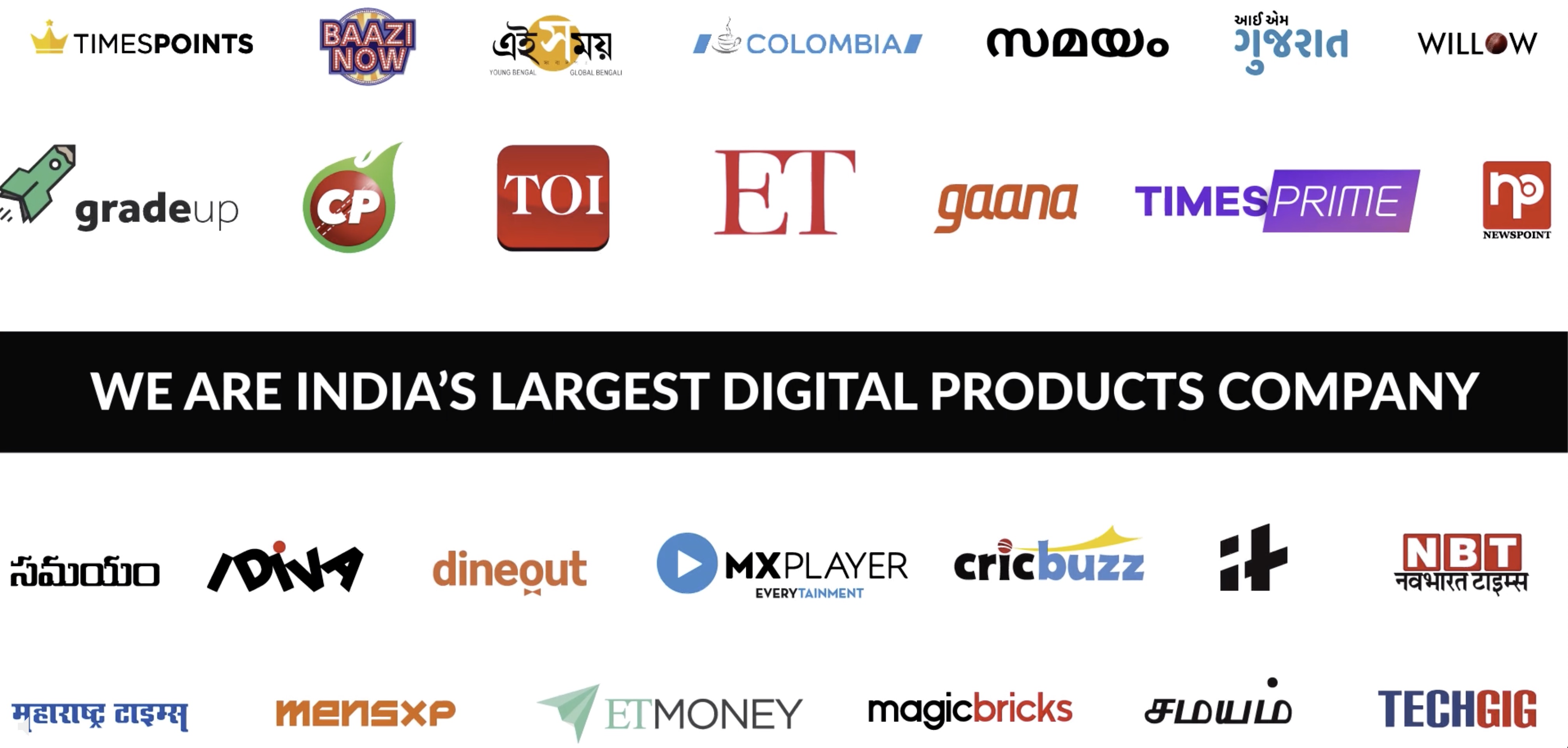
The subsidiary of 181-year-old Bennett Coleman and Company Limited (popularly known as Times Group) operates more than three dozen properties, including newspaper Times of India, online outlet Indiatimes, advertisement business Colombia, venture arm Tventures, and streaming services Gaana and MX Player. And nearly all of these properties are growing, Gajwani said.

For instance, Times Internet’s news outlets have amassed 265 million monthly active users. The Times of India, the country’s most read newspaper and news website, alone has 212 million monthly active users, up by 44% since last year. Times Internet’s regional digital periodicals such as NewsPoint, Navbharat Times, Maharashtra Times, Vijay Karnataka now have 122 monthly active users, he said.

Music streaming service Gaana, which raised $115 million from Tencent and others last year, reached 100 monthly active users in March this year, the service announced last week. MX Player, a video playback app that doubles as a streaming service that Times Internet acquired for some $140 million last year, is one of the most popular Android apps in emerging markets.

During the first month of ongoing IPL cricket tournament, one of the hottest events in India, 118 million users tuned into Times Internet’s Cricbuzz, a news and entertainment service dedicated to sports. As the ecosystem of mobile gaming begins to gain major traction in India, Times Internet says it is building a portfolio of apps in this space, too.

Its lifestyle properties such as MenXP, iDiva, and Whats Hot have 40 million monthly active users and its videos clock more than 200 million views each month. These properties are exploring an additional revenue channel by selling products directly to customers, Gajwani told TechCrunch in an interview.

Times Internet vice chairman Satyan Gajwani

Moving beyond ads

Chasing that avenue illustrates Times Internet’s growing push to grow its business beyond ads. Most of Times Internet’s properties are built on top of ads and don’t cost users anything for access. Its own advertising business, called Colombia, now supplements some advertisement on its network and is used by more than a dozen outside brands including Ola, ABP News, and Hotstar.

But online advertising still can’t compete with those of TV and print in India, Satish Meena, an analyst with research firm Forrester told TechCrunch. So in recent years, Times Internet has announced a number of subscription services across many of its properties.

“Especially for premium publishers, an ads-only business model is not likely to last or sustain in the long run,” Gajwani said. Last year, Times Internet announced Times Prime, a subscription bundle that includes access to premium version of Gaana, an ad-free experience on Times of India, and discounts on a number of third-party services such as food delivery Swiggy, retailer BigBasket, and theatre chain PVR Cinemas. Gajwani said Times Internet has hit a million customers across its subscription services.

Part of Times Internet’s push to expand its revenue channels is its growing focus on Tventures, its VC fund that made early investments in a number of startups including edtech startup Byju’s and logistics startup Delhivery, two unicorns. It has also invested in ride-hailing service Shuttl, and cricket fantasy app MPL among others.

Gajwani said Tventures looks at “use cases that can benefit from its growing network.” And that’s one of the big advantages of Times Internet’s scale. The properties they own enjoy great advertisement benefits across its sprawling network. “There are very few companies — with exception of Google and Facebook — that have our level of scale,” Gajwani said.

Times Internet, which employs over 5,000 people, also operates Times Bridge, an investment firm that ties with international brands to help them launch in India. Some of its strategic partners include Uber, Airbnb, and Coursera. It also partnered with a number of news outlets including Business Insider, TechRadar, Huffington Post (which, like TechCrunch, is owned by Verizon Media Group), AdAge, PCMag, and Gizmodo Media properties Lifehacker and Gizmodo to launch them in India.

But it isn’t all success, there have been less successful ventures particularly in the media segment.

The Indian versions of Lifehacker, Gizmodo, TechRadar, and PCMag failed to attract significant audiences in the nation and have already closed shops. Huffington Post ended its partnership with Times Internet in 2017 and it now wholly controls Huffington Post India.

Gajwani admitted that Times Internet realized working with some niche publishers isn’t so sustainable. “We have some partnerships that we maintain that are doing well such as Business Insider,” he added. Today, Times Internet is no longer primarily looking at publishers for future partnerships, and instead focusing on “platforms and technologies.”

A couple of hiccups aside, the biggest challenge for Times Internet going forward is generating sufficient revenue from ads and convincing enough users to become paying customers. Times Internet generated $202 million in fiscal year 2018 at a loss of $23 million, according to regulatory filings. In an interview last week, Gaana CEO Prashan Agarwal said his music streaming service, which dominates the market but is not profitable, will introduce a number of premium plans across a wide range of price tiers to attract users.

Gajwani said he also hopes to build Colombia into one of the biggest ad networks in India and tap 20 million paying subscribers by 2023. He said some properties within Times Network could raise additional cash from outside investors in the coming future.  These are ambitious goals, but Times Internet is one of the few firms in India that realistically has a shot at co-existing with dominant overseas tech platforms.


from Amazon – TechCrunch https://techcrunch.com/2019/04/30/indias-times-internet-isnt-ceding-ground-to-us-rivals-facebook-and-google/

AWS opens up its managed blockchain as a service to everybody

After announcing that they were launching a managed blockchain service late last year, Amazon Web Services is now opening that service up for general availability.

It was only about five months ago that AWS chief executive Andy Jassy announced that the company was reversing course on its previous dismissal of blockchain technologies and laid out a new service it would develop on top of open source frameworks like Hyperledger Fabric and Ethereum.

“Customers want to use blockchain frameworks like Hyperledger Fabric and Ethereum to create blockchain networks so they can conduct business quickly, with an immutable record of transactions, but without the need for a centralized authority. However, they find these frameworks difficult to install, configure, and manage,” said Rahul Pathak, General Manager, Amazon Managed Blockchain at AWS, in a statement. “Amazon Managed Blockchain takes care of provisioning nodes, setting up the network, managing certificates and security, and scaling the network. Customers can now get a functioning blockchain network set up quickly and easily, so they can focus on application development instead of keeping a blockchain network up and running.”

Already companies like AT&T Business, Nestlé and the Singaporean investment market, the Singapore Exchange, have signed on to use the company’s services.

With the announcement, AWS joins other big enterprise players like Azure from Microsoft and IBM in the blockchain as a service game.


from Microsoft – TechCrunch https://techcrunch.com/2019/04/30/aws-opens-up-its-managed-blockchain-as-a-service-to-everybody/