Tuesday, July 3, 2018

UK job ad indicates Amazon wants to bring TV advertising and free TV channels to Prime

People have long wondered if one of Amazon’s goals in video and advertising — two key areas in Amazon’s media strategy — ultimately would be to bring the two together, with Amazon-powered ads running in video streams also served by Amazon. A job ad in the U.K. appears to indicate that the company might be gearing up for such a play. According to the ad, the company is currently hiring for someone to lead its efforts in free-to-air TV and advertising in Europe.

Free-to-air TV refers to the range of ad-supported (or TV license-supported) TV channels that you can access through a digital TV tuner, satellite or cable without paying anything to receive them.

The advertisement for the job when it was posted four weeks ago was titled, “Head of Free to Air TV & Advertising.” Yesterday, after people started noticing it (and what it implied about Amazon’s plans), Amazon appeared to change it to a slightly more muddled “Head of Prime Video Channels Free To Air TV & Advertising TV Partner Channels.” Then this morning, as we started asking questions, the title appeared to change again, to “Head of Prime Video Partner Channels” — without any reference to free-to-view or advertising. All the ads had the same job ID number.

“Channels have launched in US, UK and Germany and this is a new and fast-growing area within Prime Video,” the advertisement reads. “As part of this expansion we are seeking a senior leader to join the European Channels & Sports team, based in London. This individual will be responsible for widening the content range with the development of free and advertising-funded channels.”

The job ad notes that the responsibilities will include developing Prime Video’s European strategy for free-to-air and advertising-funded channels; collaborating with global peers; and working with major broadcasters across Europe, “translating their requirements into Amazon capabilities and execution for our customers.”

The person will also work with various internal teams — product, tech, ad sales, marketing, finance, operations — “and act as internal champion for free-to-air and advertising funded content.”

This is notable because currently it appears that Amazon does not have any free-to-air channels on its U.K. service (and an Amazon spokesperson would not directly answer me on this point and declined to provide a comment on the record for this story), and it’s also gearing up to have some free significant sports content on its platform, in the form of Premier League football matches.

Amazon’s current Prime Video offerings in the U.K. include films and TV shows it picks up by way of licensing deals with third parties; Amazon original content; and a selection of live-streamed broadcast channels (which include HBO, Showtime and Starz for now, Discovery and Eurosport in the U.K., as part of Amazon Channels, launched in March 2017). We’ve also heard it has been eyeing purchasing at least one commerce-minded broadcaster outright. Globally, Prime Video is live in 200 countries worldwide.

But as with its TV streams in the U.S., the TV streams in the Channels list are focused on premium subscriptions, where users have to pay extra fees, on top of their Prime subscriptions, to get the extra channels.

Offering free-to-air would be a significant move for the company not only because it would be “free,” but because it would represent a large jumpstart on the amount of content that Amazon presents to its users. Bringing in what are essentially table stakes in TV services, a large range of free channels could be another way of attracting more would-be cord cutters to switch over to Amazon for all of their video and TV interests, rather than using Amazon’s video offerings as a supplement to a core service from another provider.

And that, in turn, could become one more sweetener — alongside the other free video services, the free shipping, and many other perks — for people to pony up for the Prime annual subscription.

Amazon has never disclosed figures for how many viewers it has for its video service, in the U.K. or elsewhere, but a document leaked earlier this year that said it had 26 million viewers of its video content in early 2017. The company is estimated to be putting $5 billion per year into original content production and licensing content to drive more audience to its platforms, which it ties to its ultimate drive for more shopping on Amazon.

“When we win a Golden Globe, it helps us sell more shoes,” CEO Jeff Bezos has been quoted as saying.

That strategy is also playing out in the U.K., where Amazon recently won the rights to stream 20 Premier League football matches in the 2019/2020 season — which it will show to viewers at no extra charge, another twist on the “free to view.”

Amazon has not disclosed the price it paid, but as a point of comparison, BT is paying £975 million for 52 live games a season for three years, while Sky is paying £3.75 billion for 128 live games.

Ramping up the amount of streamed, free content on Amazon’s platform will pave the way for the other part of the job Amazon is seeking to fill: advertising.

Currently, Amazon does not sell ads into any of the live-streamed channels on its platform, although some of them do run ads. However, if Amazon were to scale up the advertising opportunity by way of popular sports content and a wider range of free-to-air channels, suddenly the idea of creating its own TV-based ad network to inject ads into those various streams might be a little more compelling both to Amazon and would-be advertisers.

In the U.S., Amazon has dipped its toes in the waters by running ads during broadcasts of NFL games it had acquired the rights to broadcast — although by one account advertisers were paying up to $1 million less than Amazon had hoped they would for their packages.

Amazon has been quite gradual in building out its ads business. The company made $4 billion in advertising revenues in 2017, from a variety of services that range from native ads across third-party websites, through to banners on top of the Fire TV landing page and display units that run on Kindle devices. Its ad business is projected to make $9.5 billion in 2018. Relatively speaking, this is still modest in comparison to Google, which made $95 billion in advertising revenues in 2017.

But while Amazon slowly grows its ads business, it’s also chopping and changing, and it appears that one aim is to focus more on opportunities that speak to more scale for the business overall.

Just last week, we reported that Amazon quietly announced that it would be retiring an ad unit called CPM Ads, one of its earlier efforts in building a display network, which was aimed at smaller websites that were a part of its Associates program.


from Amazon – TechCrunch https://techcrunch.com/2018/07/03/amazon-free-tv-ads/

A bigger Amazon Prime Day 2018 arrives July 16 with more deals, devices and longer hours

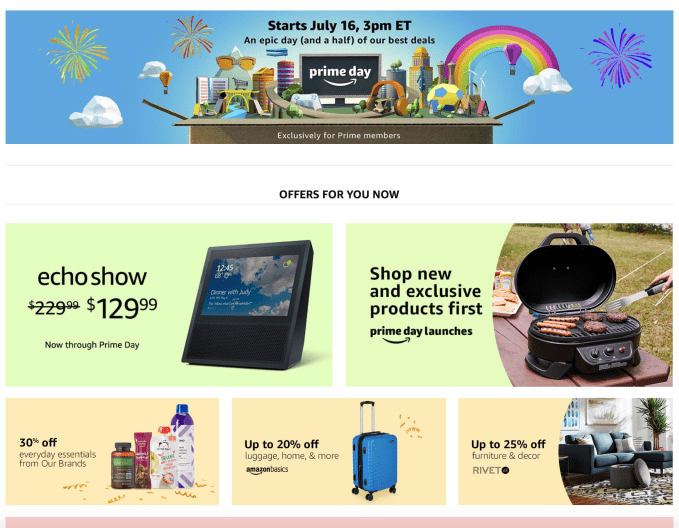
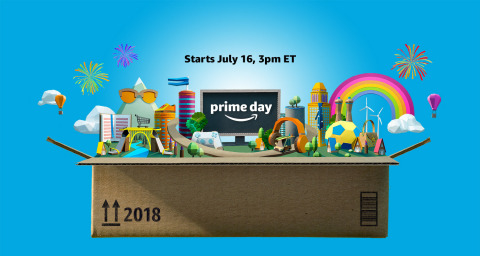
Amazon’s Prime Day, the company’s annual sales event that’s now its biggest, will be held this year on July 16, starting at 12 PM PT/3 PM ET, and will feature over a million deals, the retailer announced today. One big change this time around is the event’s length — last year, Prime Day ran 30 hours, but this year’s event will run for 36 hours. In addition to being the longest Prime Day to date, the event will also expand to new markets this year, says Amazon.

Australia, Singapore, Netherlands and Luxembourg will join the other countries hosting Prime Day this year, which includes the U.S., U.K., Spain, Mexico, Japan, India, Italy, Germany, France, China, Canada, Belgium and Austria.

As in previous years, Amazon is touting deals across product categories, like TVs, smart home, kitchen, grocery, toys, fashion, furniture, appliances, back-to-school supplies and everyday essentials.

Of course, Amazon will again mark down its own devices for Prime Day, and it’s teasing some of its deals in advance. The retailer says it will offer “double the deals” on Amazon devices, including the lowest prices to date on Echo, Fire TV and Fire tablets.

The expanded number of deals comes from Amazon now owning more hardware brands. For example, it acquired the smart doorbell maker Ring earlier this year, and the smart camera and doorbell startup Blink back in December. Today, it’s selling a suite of home security products that includes these brands and others, like its own Echo Dot and Amazon Cloud Cam.

These could be the “home security devices” that will be newly on sale this year during Prime Day, alongside the Echo Show.

Also new this year is Amazon bringing Prime Day to Whole Foods.

Prime members shopping in-store can take an additional 10 percent off hundreds of sales items and will receive other deep discounts on popular products, Amazon says. Plus Prime Rewards Visa card members will receive double the rewards — 10 percent back — July 14 through 17 when shopping Whole Foods.

In addition to the usual slate of deals, some brands are unveiling new products, new content or special edition products for Prime Day 2018.

This list includes the new Delta Trinsic Touch2O, the first Alexa-enabled kitchen faucet; Coleman RoadTrip LXE portable propane grill; Fingerlings Light Up Unicorn Mackenzie; an Audible Original production, Hi Bob!, which has Bob Newhart sitting down with guests Sarah Silverman, Will Ferrell, Lisa Kudrow, Jimmy Kimmel, Judd Apatow and Conan O’Brien; an exclusive version of the Moto G6 64 GB, and more.

Amazon is kicking off the Prime Day deals starting immediately, however.

The following items are already on sale:

  • Echo Show – save $100 (normally $229)
  • Amazon brands – 25 percent off furniture and décor from Rivet and Stone & Beam, up to 20 percent off AmazonBasics items and 30 percent off everyday essentials from Presto!, Mama Bear and Solimo, and others
  • Prime Video, DVD, and Blu-ray – save up to 50 percent on select movies and TV shows
  • Amazon Music – four months of on-demand music for $0.99
  • Twitch Prime – hundreds of hours of free gameplay and free PC game giveaway every day until July 18, and more
  • Kindle Unlimited and eBooks – three months of Kindle Unlimited for $0.99; $10 Prime Day credit for buying your first Kindle book
  • Audible – first three months for $4.95/month (65 percent off)

During Prime Day, Amazon is adding 50 percent more Spotlight Deals, and will feature deals across the following: Watch a Deal (deal notifications from the Amazon app); Prime Day Sneak Peek (sneak peek at deals in the app from July 9-15); deals by Popular Interests (deals organized by 40 of the most shopped interests); Alexa Shopping (ask Alexa for deals); Amazon Prime Credit Cards (5 percent back on Prime Day purchases).

To encourage Alexa shopping this year, Amazon is offering customers a chance to win a sweepstakes where a grand prize winner will get an Alexa-enabled 2019 Lexus ES, a complete Alexa smart home package and more. This is a big step up from the Alexa shopping perks from last year, which included $10 for first-time Alexa voice shoppers.

Prime Day began as a way to drive more consumers to subscribe to Amazon’s annual Prime membership program, which now has more than 100 million paid members. However, because of the numerous deals available, it’s also become a sales event that outpaces Black Friday, Cyber Monday and other sales holidays for Amazon. Prime Day 2017, for example, was the biggest sales day in history for Amazon, up 60 percent from the year before.

With Amazon doubling down on the event this time around, with even more device deals, Whole Foods deals, market expansions and longer hours, it will likely break records again.


from Amazon – TechCrunch https://techcrunch.com/2018/07/02/a-bigger-amazon-prime-day-2018-arrives-july-16-with-more-deals-devices-and-longer-hours/

Light is building a smartphone with five to nine cameras

Light, the company behind the wild L16 camera, is building a smartphone equipped with multiple cameras. According to The Washington Post, the company is prototyping a smartphone with five to nine cameras that’s capable of capturing a 64 megapixel shot.

The entire package is not much thicker than an iPhone X, the Post reports. The additional sensors are said to increase the phone’s low-light performance and depth effects and uses internal processing to stick the image together.

This is the logical end-point for Light. The company introduced the $1,950 L16 camera back in 2015 and starting shipping it in 2017. The camera uses 16 lenses to capture 52 megapixel imagery. The results are impressive, especially when the size of the camera is considered. It’s truly pocketable. Yet in the end, consumers want the convenience of a phone with the power of a dedicated camera.

Light is not alone in building a super cameraphone. Camera maker RED is nearing the release of its smartphone that rocks a modular lens system and can be used as a viewfinder for RED’s cinema cameras. Huawei also just released the P21 Pro that uses three lenses to give the user the best possible option for color, monochrome and zoom. Years ago, Nokia played with high megapixel phones, stuffing a 41 MP sensor in the Lumia 1020 and PureView 808.

Unfortunately, additional details about the Light phone are unavailable. It’s unclear when this phone will be released. We reached out to Light for comment and will update this report with its response.


from Microsoft – TechCrunch https://techcrunch.com/2018/07/03/light-is-building-a-smartphone-with-five-to-nine-cameras/

Airwallex raises $80M for its international payment service for businesses

Airwallex, a three-year-old fintech startup focused on international payments for SMEs and businesses, is putting itself on the map after it raised an $80 million Series B round.

Based of out of Melbourne, but with six offices in Asia and other parts of the world, Airwallex’s new funding round is the second largest financing deal for an Australian startup in history. The round was led by existing investors Tencent, the $500 billion Chinese internet giant, and Sequoia China. Other participants included China’s Hillhouse, Horizons Ventures — the fund from Hong Kong’s richest man Li Ka-Shing — Indonesia-based Central Capital Ventura (BCA) and Australia’s Square Peg, a firm from Paul Bassat who took recruitment firm Seek to IPO and is one of Australia’s highest-profile founders.

The financing takes Airwallex to $102 million raised. Tencent led a $13 million Series A in May 2017, while Square Peg added $6 million more via a Series A+ in December. Mastercard is also a backer; the finance giant uses Airwallex to handle its “Send” product while Tencent uses the service to power an overseas remittance service for its WeChat app.

Airwallex handles cross-border transactions for companies that do business in multiple countries using international currencies. So it’s not unlike a Transferwise-style service for SMEs that lack the capital to develop a sophisticated (and expensive) international banking system of their own.

The service uses wholesale FX rates to route overseas payments back to a client’s domestic bank and is capable of processing “thousands of transactions per second,” according to the company. A use case example might include helping a China-based seller return money earned in the U.S. or Europe via Amazon or other e-commerce services, or route sales revenue back directly from their own website.

Airwallex CEO Jack Zhang (far right) on stage at TechCrunch Shenzhen in 2017

China is a key market for Airwallex — which was started by four Australian-Chinese founders — as well as the wider Asian region, and in particular Australia, Hong Kong and Southeast Asia. With this new capital, Airwallex co-founder and CEO Jack Zhang said the company will increase its focus on Hong Kong and Southeast Asia, whilst also extending its business in Europe (where it has a London-based office) and pushing into North America.

Product R&D is shared across Melbourne and Shanghai, while Hong Kong accounts for business development, compliance and more, Zhang explained. However, Airwallex’s locations in London and San Francisco are likely to account for most of the upcoming headcount growth planned following this funding. Right now, Airwallex has around 100 staff, according to Zhang.

The company is also aiming to expand its product range, too.

The firm is in the process of applying for a virtual banking license in Hong Kong, a third-party payment license in mainland China, and a cross-border Chinese yuan license. One goal, Zhang revealed, is to offer working capital loans to SMEs to help them to scale their businesses to the next level. Airwallex is working with an undisclosed partner to underwrite deals in the future. Zhang explained that the company sees a gap in the market since banks don’t have access to critical data on clients for loan assessments.

More generally, he’s bullish for the future despite Brexit and the ongoing trade war between the U.S. and China.

“The trade war gives the Chinese yuan a lot of vitality, and we’ve seen more demand in the market. China’s belt road initiative has really taken off, too, and we’re seeing the impact in many many of our payment corridors,” he explained. “Business has been booming, especially as traditional offline SMEs start to move online and go from domestic to global.”

“We want to be the backbone to support these new opportunities for businesses,” Zhang added.


from Amazon – TechCrunch https://techcrunch.com/2018/07/03/airwallex-raises-80m/

The perils of the discard pile

If you’ve got a big bowl of pistachios, it’s worth avoiding the costly error of putting the shells back into the serving bowl. The more you do that, the harder it is to actually find a useful pistachio going forward. Better to have a discard pile, which means that the chances you’ll get a good one from the big bowl are 100%.

On the other hand, if you and your team are in the habit of putting ideas, “that will never work,” in a permanent pile of discards, you’re almost certainly missing great opportunities. There’s a difference between, “that didn’t work once, under certain conditions,” and, “that will never work.”

Alas, we do the same thing with people. Errors in both directions.

Be careful with your discards.


from Seth Godin's Blog on marketing, tribes and respect http://feeds.feedblitz.com/~/556086948/0/sethsblog~The-perils-of-the-discard-pile/

Monday, July 2, 2018

Do-ability

When we were in fifth grade, our options were severely limited. Not so much now.

In a world without tests and lowered boundaries (i.e. the world adults like you that read this are living in) we have far more degrees of freedom than we realize.

And yet we drift toward convenience.

Ease and convenience.

Ease, convenience and the freedom from the fear of failure.

We were taught compliance from an early age. The opposite of compliance, we’re told, is failure. In order to amplify compliance, people in authority have instilled in us not just a fear of failure, but worse, a fear of fear.

The reason it’s hard to push ourselves, even when there’s no external downside of doing so, is our fear of fear of failure. That feeling, the feeling of insufficiency and doom, pushes us to seek the comfort of compliance instead.

Wikipedia is the result of a billion edits. Each edit is fairly trivial, and the articles that are the most edited are often on trivial topics, like the more than 5,000 words written about Don Draper. It’s easy and safe and fun to write endlessly about a fictional character, while we avoid speaking up about the real things.

At the same time, WikiTribune, a news-focused site built on the same principles, has very little activity. The reason is that it’s not trying to solve a finite problem (adding a paragraph about Don Draper’s affair) but an infinite one, because there is too much news to keep up with. WikiTribune doesn’t need people to fix typos, they’re asking for contributions that are almost certainly going to be challenged. It’s not a do-able problem, so contributing feels like a brush with failure.

We see the same thing happen with books (short ones are easier to sell than long ones, even at the same price) or online education (a short course on calligraphy will do far better than a six-month deep dive into the Stoics.)

It’s essential that we differentiate between things that remind us of fear and those that are actually risky. In our adult world, the most valuable activities are actually inconvenient, fraught with the fear of failure and apparently un-do-able.

Without someone telling us what to do, without a test to prove that we did it, it’s easy to slip into the dumb lane. Dumb, simple, easy, do-able.

But what if we committed to the other path. To find a way to allocate our time to things that might not work?


[The altMBA is inconvenient. It’s not designed to protect you from the fear of fear. It’s do-able but there are days it won’t feel that way. Perhaps that’s why it works. Today is the first priority deadline.]


from Seth Godin's Blog on marketing, tribes and respect http://feeds.feedblitz.com/~/555842094/0/sethsblog~Doability/

Sunday, July 1, 2018

The thing about propellant

The paint in the can almost always lasts longer than the aerosol does.

The propellant is more difficult to engineer and work with than the stuff it’s propelling.

It’s volatile, elusive and doesn’t last long.

The metaphor is a useful way to think about your situation. You might not need more time. You might not need more connections. You might not need to move to a new city, find new friends or catch a lucky break.

It may be that all you need is to use your propellant more wisely.

[There’s a significant exception to this rule: The rare person who is all propellant. No useful substance, no long-term strategy, simply short-term success based on an abundance of forward motion. If you work with someone like that, try to help them find their way… they’re not going to stop moving, but perhaps you can help them move in the right direction.]


from Seth Godin's Blog on marketing, tribes and respect http://feeds.feedblitz.com/~/555677300/0/sethsblog~The-thing-about-propellant/