Panoply, a platform that makes it easier for businesses to set up a data warehouse and analyze that data with standard SQL queries, today announced that it has raised an additional $10 million in funding from Ibex Investors and C5 Capital. This brings the total funding in the San Francisco- and Tel Aviv-based company to $24 million.
The company, which launched back in 2015, has mostly stuck to its original vision, which was always about democratizing access to data warehousing and the analytics capabilities that go hand-in-hand with that. Over the last few years, it also built more code-free data integrations into the platform that make it easier for businesses to pull in data from a wide variety of sources, including the likes of Salesforce, HubSpot, NetSuite, Xero, Quickbooks, Freshworks and others. It also integrates with other data warehousing services like Google’s BigQuery and Amazon’s Redshift and all of the major BI and analytics tools.
The company says it will use the new funding to expand its sales and marketing efforts.
“We aspire to make analysts’ lives simpler and more productive by making it easier for them to sync, store, and access their data, and this funding will go a long way toward that mission,” says CEO and co-founder Yaniv Leven in today’s announcement.
In some ways, Panoply was maybe just a bit early to the market. Today, though, there can be little doubt that we’re in a booming market for data warehousing and analytics services. There’s nary a business left, after all, that isn’t looking to gain more insights from the copious amounts of data they gather every single day now. That market is now more competitive than ever, too, with incumbents like Snowflake, Databricks and others (including all of the hyper clouds) all aiming for their slice of the market. Panoply and its investors clearly believe that the company’s all-in-one platform gives it a competitive edge, though.
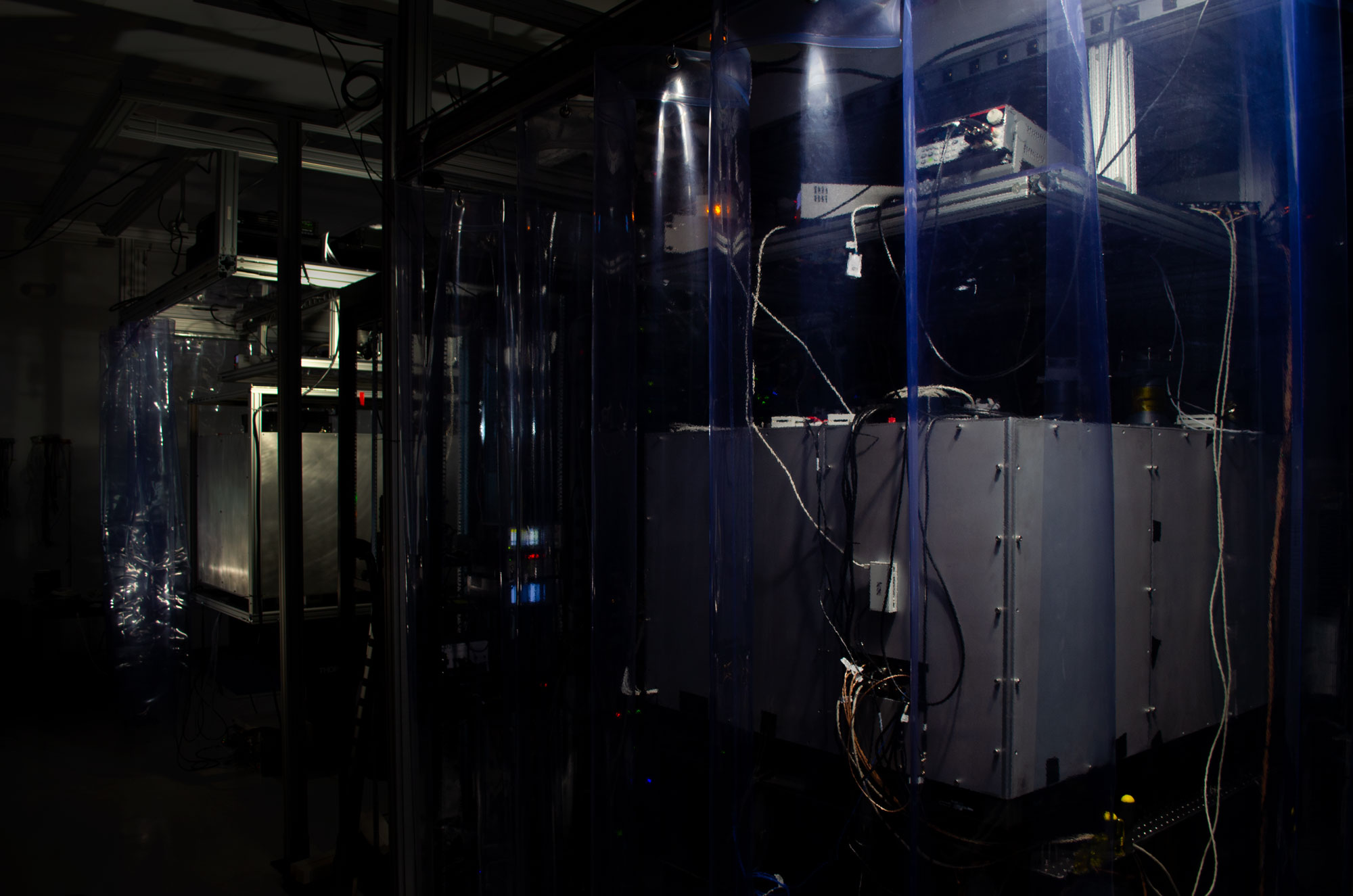
Trapped-ion quantum computing startup IonQ today announced the launch of its latest quantum computer, which features what IonQ calls “32 perfect qubits with low gate errors.”
Using IBM’s preferred quantum benchmark, IonQ expects to hit a quantum volume of 4,000,000. That’s a massive increase over the double-digit quantum volume numbers that IBM itself recently announced and it’s a pretty extraordinary claim on IonQ’s side as this would make its system the most powerful quantum computer yet.
The (well-funded) company has never used this metric before. Through a spokesperson, IonQ also noted that it doesn’t necessarily think quantum volume is the best metric, but since the rest of the industry is using it, it decided to release this number. The company argues that its ability to achieve 99.9% fidelity between qubits has allowed it to achieve this breakthrough.
“In a single generation of hardware, we went from 11 to 32 qubits, and more importantly, improved the fidelity required to use all 32 qubits,” said IonQ CEO and president Peter Chapman. “Depending on the application, customers will need somewhere between 80 and 150 very high fidelity qubits and logic gates to see quantum advantage. Our goal is to double or more the number of qubits each year. With two new generations of hardware already in the works, companies not working with quantum now are at risk of falling behind.”
Image Credits: Kai Hudek, IonQ
It’s worth noting that IonQ’s trapped-ion approach is quite different from IBM’s (or D-Wave’s for that matter) which uses a very different technique. That makes it hard to compare raw qubit counts between different vendors. The quantum volume metric is meant to make it easier to compare these systems, however.
“The new system we’re deploying today is able to do things no other quantum computer has been able to achieve, and even more importantly, we know how to continue making these systems much more powerful moving forward,” said IonQ Co-Founder & Chief Scientist Chris Monroe. “With our new IonQ system, we expect to be able to encode multiple qubits to tolerate errors, the holy grail for scaling quantum computers in the long haul.”
Using new error correction techniques, IonQ believes that it will only need 13 qubits to create a “near-perfect” logical qubit.
For now, IonQ’s new system will be available as a private beta and it’ll be interesting to see if its early users will back up the company’s claims (unsurprisingly, given the magnitude of IonQ’s claims, there’s a bit of skepticism within the quantum computing community). Later, the company will make it available through partners like Amazon with its Braket service and the Microsoft Azure Quantum Cloud.
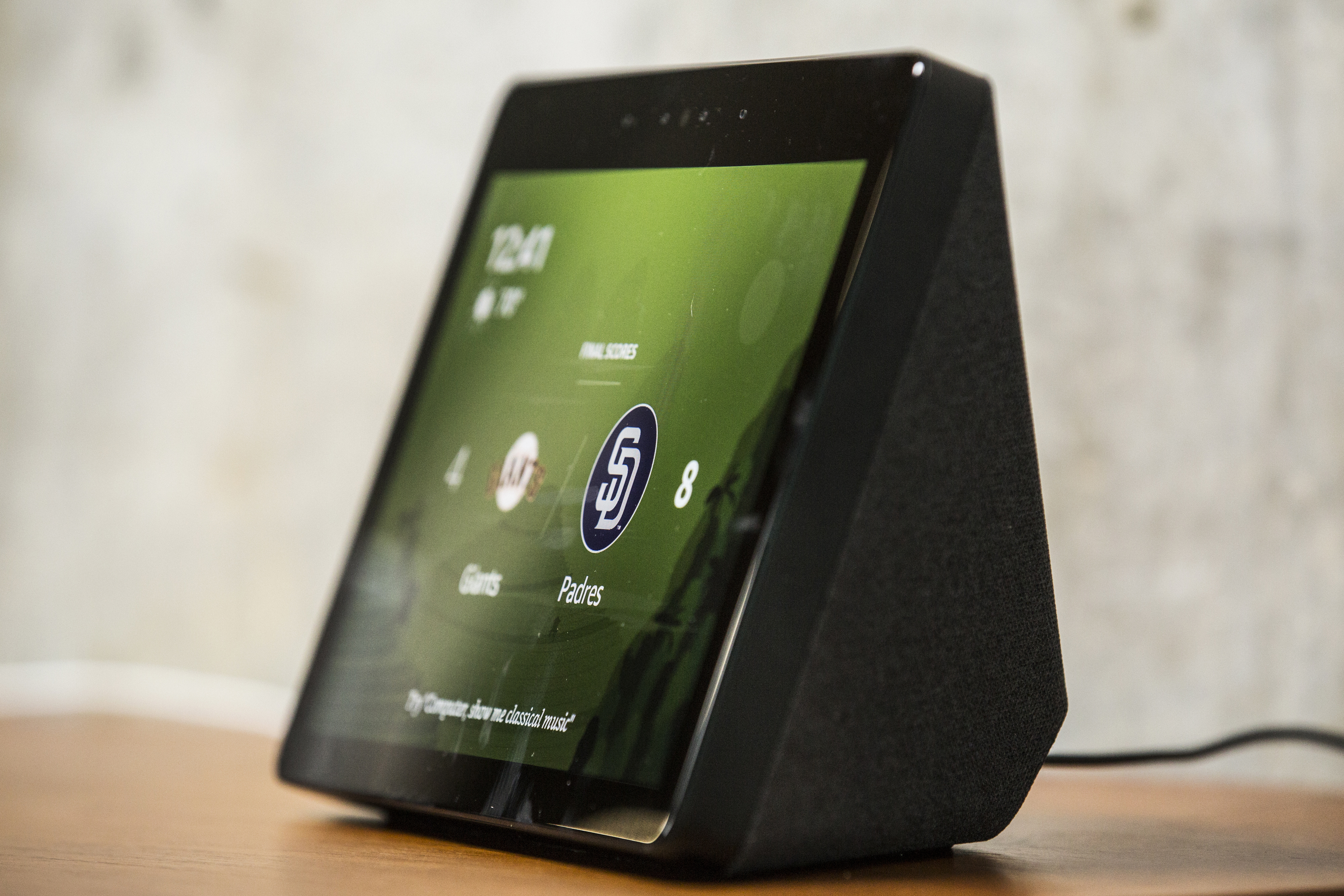
At its annual hardware event, Amazon today announced new capabilities for its Alexa personal assistant that will allow it to become more personalized as it can now ask clarifying questions and then use this personalized data to interact with the user later on. In addition, Alexa can now join a conversation, too, starting a mode where you don’t have to say ‘hey Alexa’ all the time. With that, multiple users can interact with Alexa and the system will chime in when it’s appropriate (or not — since we haven’t tested this yet).
As Amazon VP and head scientist Rohit Prasad noted, the system for asking questions and personalizing responses uses a deep learning-based approach that allows Alexa to acquire new concepts and actions based on what it learns from customers. Whatever it learns is personalized and only applies to this individual customer.
When you ask Alexa to set the temperature to your ‘favorite setting,’ for example, she will now ask what that setting is.
In addition, Alexa can now adapt its speaking style depending on the context, based on the team’s ability to better understand how to generate a natural-sounding voice for Alexa. In an example today, Amazon showed what that means when you ask it to play music for example, with Alexa having a bit more pep in its voice compared to its regular, somewhat monotone voice.
The real breakthrough, though, is the conversation mode. To enable this, users have to say: “Alexa, join our conversation.” In today’s demo, the company showed how Alexa could work when you’re ordering a pizza, for example. One of the actors said she wasn’t that hungry and wanted a smaller pizza. Alexa automatically changed that order for her. The team calls this ‘natural turn taking.’
from Amazon – TechCrunch https://techcrunch.com/2020/09/24/amazons-alexa-becomes-a-better-conversationalist-and-can-now-ask-you-questions-too/
WhyLabs, a new machine learning startup that was spun out of the Allen Institute, is coming out of stealth today. Founded by a group of former Amazon machine learning engineers, Alessya Visnjic, Sam Gracie and Andy Dang, together with Madrona Venture Group principal Maria Karaivanova, WhyLabs’ focus is on ML operations after models have been trained — not on building those models from the ground up.
Visnjic, the company’s CEO, used to work on Amazon’s demand forecasting model.
“The team was all research scientists, and I was the only engineer who had kind of tier-one operating experience,” she told me. “So it was like, ”Okay, how bad could it be?’ I carried the pager for the retail website before it can be bad. But it was one of the first AI deployments that we’d done at Amazon at scale. The pager duty was extra fun because there were no real tools. So when things would go wrong — like we’d order way too many black socks out of the blue — it was a lot of manual effort to figure out why was this happening.”
Image Credits: WhyLabs
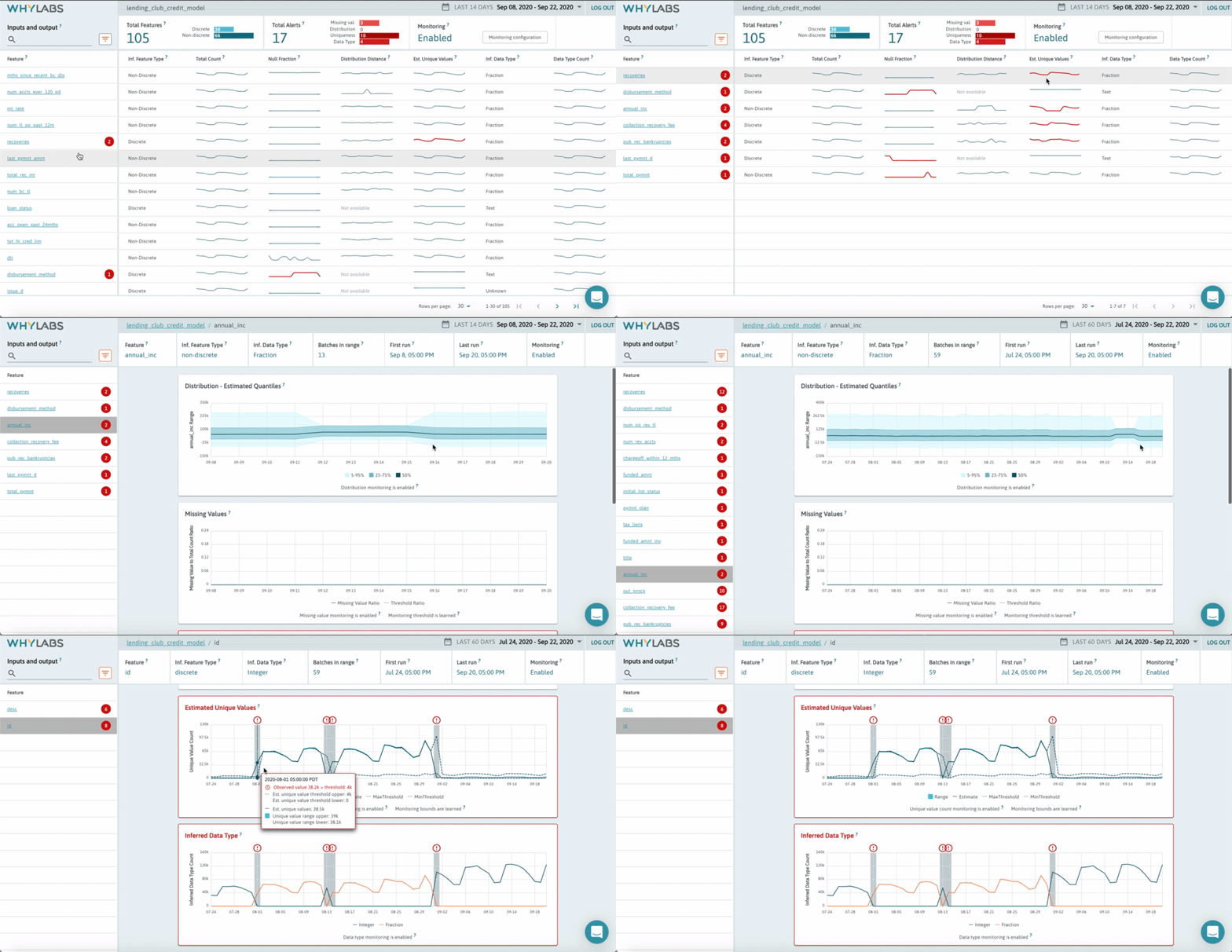
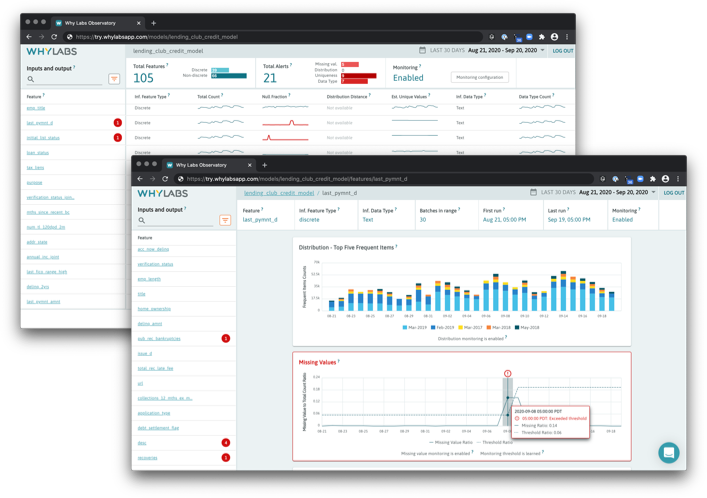
But while large companies like Amazon have built their own internal tools to help their data scientists and AI practitioners operate their AI systems, most enterprises continue to struggle with this — and a lot of AI projects simply fail and never make it into production. “We believe that one of the big reasons that happens is because of the operating process that remains super manual,” Visnjic said. “So at WhyLabs, we’re building the tools to address that — specifically to monitor and track data quality and alert — you can think of it as Datadog for AI applications.”
The team has brought ambitions, but to get started, it is focusing on observability. The team is building — and open-sourcing — a new tool for continuously logging what’s happening in the AI system, using a low-overhead agent. That platform-agnostic system, dubbed WhyLogs, is meant to help practitioners understand the data that moves through the AI/ML pipeline.
For a lot of businesses, Visnjic noted, the amount of data that flows through these systems is so large that it doesn’t make sense for them to keep “lots of big haystacks with possibly some needles in there for some investigation to come in the future.” So what they do instead is just discard all of this. With its data logging solution, WhyLabs aims to give these companies the tools to investigate their data and find issues right at the start of the pipeline.
Image Credits: WhyLabs
According to Karaivanova, the company doesn’t have paying customers yet, but it is working on a number of proofs of concepts. Among those users is Zulily, which is also a design partner for the company. The company is going after mid-size enterprises for the time being, but as Karaivanova noted, to hit the sweet spot for the company, a customer needs to have an established data science team with 10 to 15 ML practitioners. While the team is still figuring out its pricing model, it’ll likely be a volume-based approach, Karaivanova said.
“We love to invest in great founding teams who have built solutions at scale inside cutting-edge companies, who can then bring products to the broader market at the right time. The WhyLabs team are practitioners building for practitioners. They have intimate, first-hand knowledge of the challenges facing AI builders from their years at Amazon and are putting that experience and insight to work for their customers,” said Tim Porter, managing director at Madrona. “We couldn’t be more excited to invest in WhyLabs and partner with them to bring cross-platform model reliability and observability to this exploding category of MLOps.”
from Amazon – TechCrunch https://techcrunch.com/2020/09/23/whylabs-brings-more-transparancy-to-ml-ops/
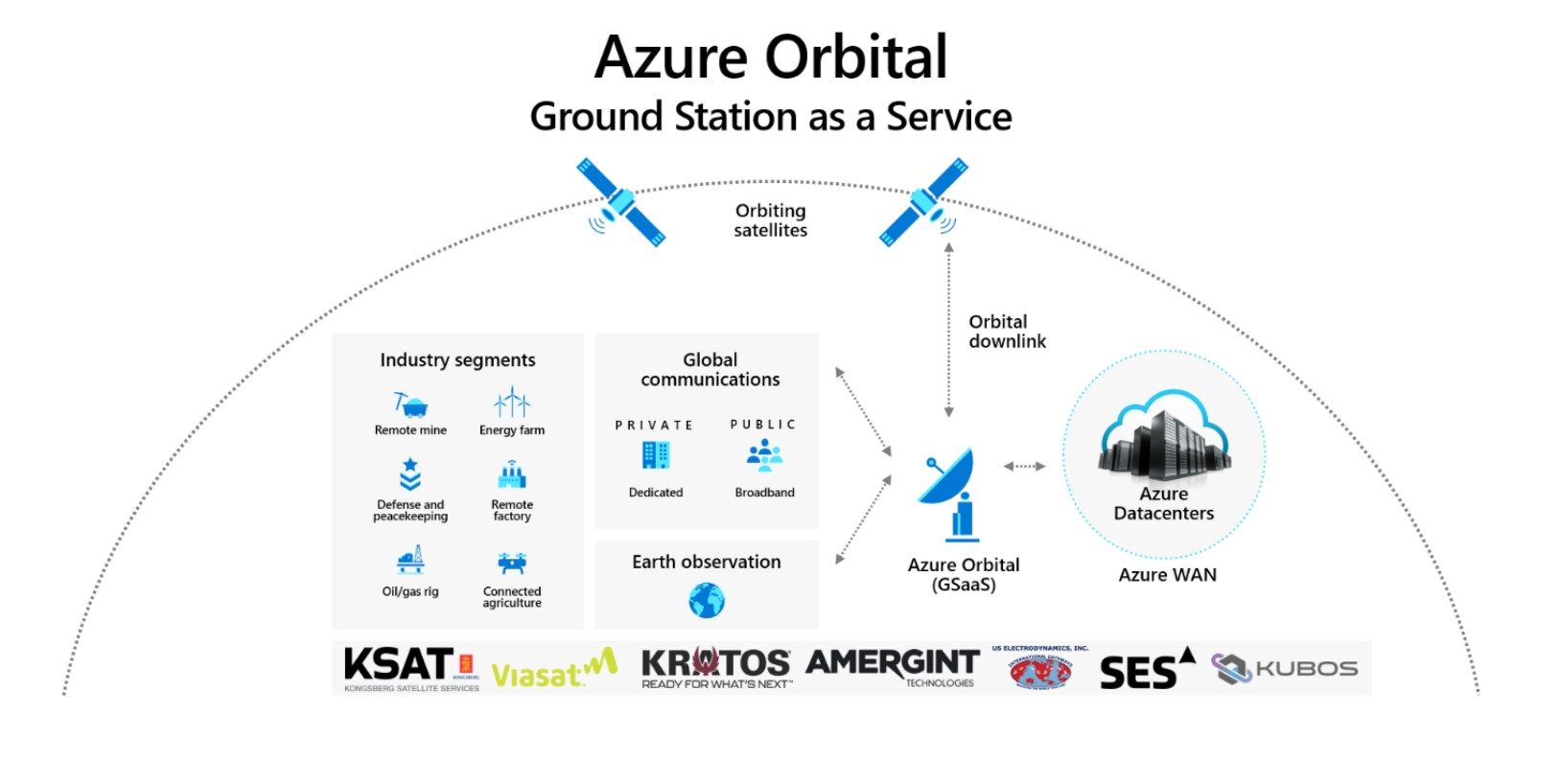
At its (virtual) Ignite conference, Microsoft today announced the launch of Azure Orbital, a new service that is meant to give satellite operators a complete platform to communicate with their satellites and process data from them — including the ground stations to receive those signals.
The company is specifically positioning the services as a solution for working with geospatial data and itis already partnering with Amergint, Kratos, KSAT, KubOS, Viasat, US Electrodynamics and Viasat to bring the service to market.
Image Credits: Microsoft
“Microsoft is well-positioned to support customer needs in gathering, transporting, and processing of geospatial data,” Yves Pitsch, Principal Product Manager, Azure Networking, writes in today’s blog post. “With our intelligent cloud and edge strategy currently extending over sixty announced cloud regions, advanced analytics, and AI capabilities coupled with one of the fastest and most resilient networks in the world – security and innovation are at the core of everything we do.”
Image Credits: Microsoft
The promise here is that satellite operators will be able to run not just the data analysis on Microsoft’s cloud but all of their digital ground operations. That includes the ability to schedule contacts with their spacecraft over Microsoft’s owned and operated ground stations (using X, S and UHF frequencies). That data can then immediately flow into Azure’s various solutions for storage, analysis and machine learning.
With AWS Ground Stations, Amazon already offers a similar ground station-as-a-service product that also includes a global network of antennas and direct access to the AWS cloud. AWS went one step further, though, and recently launched a dedicated business unit for aerospace and satellite solutions.
Last year, Amazonannounced its Sidewalk network, a new low-bandwidth, long-distance wireless protocol it developed to help connect smart devices inside and — maybe even more importantly — outside of your home. Sidewalk, which is somewhat akin to a mesh network that, with the right amount of access points, could easily cover a whole neighborhood, is now getting closer to launch.
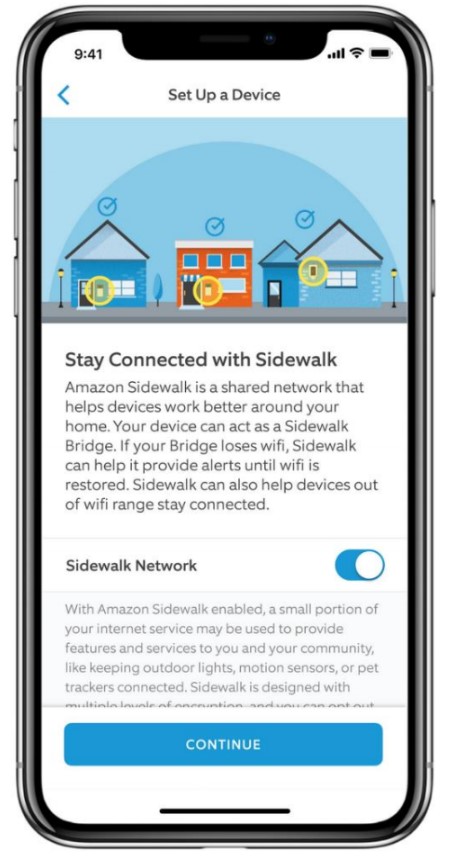
As Amazon announced today, compatible Echo devices will become Bluetooth bridges for the Sidewalk network later this year and select Ring Floodlight and Spotlight Cams will also be part of the network. Since these are low-bandwidth connections, Amazon expects that users won’t mind sharing a small fraction of their bandwidth with their neighbors.
In addition, the company also announced that Tile will be the first third-party Sidewalk device to use the network when it launches its compatible tracker in the near future.
When Amazon first announced Sidewalk, it didn’t quite detail how the network would work. That’s also changing today, as the company published a whitepaper about how it will ensure privacy and security on this shared network. To talk about all of that — and Amazon’s overall vision for Sidewalk — I sat down with the general manager of Sidewalk, Manolo Arana.
Image Credits: Amazon
Arana stressed that we shouldn’t look at Sidewalk as a competitor to Thread or other mesh networking protocols. “I want to make sure that you see that Sidewalk is actually not competing with Thread or any of the other mesh networks available,” he said. “And indeed, when you think about applications like ZigBee and Z-Wave, you can connect to Sidewalk the same way.” He noted that the team isn’t trying to replace existing protocols but just wants to create another transport mechanism — and a way to manage the radios that connect the devices.
And to kickstart the network and create enough of a presence to allow homeowners to connect their smart lights at the edge of their properties, for example, what better way for Amazon than to use the Echo family of devices.
“Echos are going to serve as bridges, that’s going to be a big thing for us,” Arana said. “You can imagine the number of customers that will benefit from that feature. And for us to be able to have that kind of service, that’s super important. And Tile is going to be the first edge device, the first Sidewalk-enabled device, and they’ll be able to track your valuables, your wallet, whatever it is that you love.”
And in many ways, that’s the promise of Sidewalk. You share a bit of bandwidth with your neighbors and in return, you get the ability to connect to a smart light in your garden that would otherwise be outside of your own network, for example, or get motion sensor alerts even when your home WiFi is out, or to track your lost dog who is wearing a smart pet finder (something Amazon showed off when it first announced Sidewalk).
Image Credits: Amazon
In today’s whitepaper, the team notes that Amazon will make sure that shared bandwidth is capped and provide a simple on/off control for compatible devices to give users the choice to participate. The maximum bandwidth a device can use is capped at 500MB and the bandwidth between a bridge and the Sidewalk server in the cloud won’t exceed 80Kbps.
The overall architecture of the Sidewalk service is pretty straightforward. The endpoint, say a connected garden light, talks to the bridge (or gateway, as Amazon also calls it in its documentation). Those gateways will use Bluetooth Low Energy (BLE), Frequency Shift Keying (FSK) and LoRa in the 900 MHz band connect to the devices on one side — and then talk to the Sidewalk Network server in the cloud on the other.
That network server — which is operated by Amazon — manages incoming packets and ensure that they come from authorized devices and services. The server then talks to the application server, which is either operated by Amazon or a third-party vendor.
Image Credits: Amazon
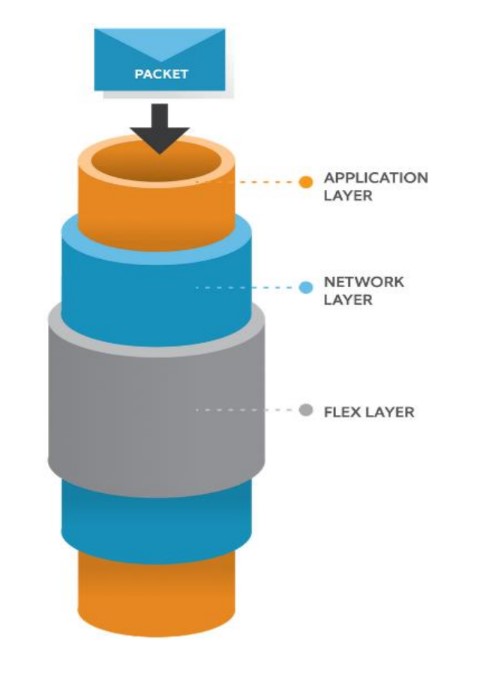
All these communications are encrypted multiple times and even Amazon won’t be able to know the commands or messages that are being passed through the network. There are three layers of encryption here. First, there’s the application layer that enables the communication between the application server and the endpoint. Then, there’s Sidewalk’s network layer, which protects the packets over the air and in addition, there’s the so-called Flex layer which is added by the gateway and which provides the network server with what Amazon calls “a trusted reference of message-received time and adds an additional layer of packet confidentiality.”
In addition, whatever routing information Amazon receives is purged ever 24 hours and device IDs are regularly rotated to ensure data can’t be tied to individual customers, in addition to using one-way hashing keys and other cryptographic techniques.
Arana stressed that the team decided not to go public with this project until it had gone through extensive penetration tests, for example, and added kill switches and advanced security features. The team also developed novel techniques to provision devices inside the network securely.
He also noted that the silicon vendors who want to enable their products for Sidewalk have to go through an extensive testing procedure.
“When you look at the level of security requirements for the silicon to be part of Sidewalk, many of our silicon [vendors] haven’t been qualified, just because it needs to be the new version, it needs to have certain secure boot features and things. That has been quite an eye-opener for everyone, to see that IoT is definitely improving — and it is going to get to a super level — but there’s a lot of work to do and this is part of it. We took it on and embraced that security level to the maximum and the vendors have been extremely positive and forthcoming working with us.”
Among those vendors the team has been working with are Silicon Labs, Texas Instruments and Nordic Semiconductor.
To test Sidewalk, Amazon partnered with the Red Cross to run a proof of concept implementation to help it track blood collection supplies between its distribution centers and donation sites.
“What we do with this is very simple tracking,” Arana said. “If you think about what they need, it is: did [the supplies] leave the building? Did they arrive at the other building? And it’s just it’s an immense simplification for them in terms of the logistics and creates efficiencies in terms of the distribution of those [supplies].”
This is obviously not so much a consumer use case, but it does show the potential for Sidewalk to also take on more industrial use cases over time. As of now, that’s not necessarily what the team is focusing on, but Arana noted that there are a lot of use cases where Sidewalk may be able to replace cell networks to provide IoT connectivity for sensors and other small edge devices that don’t have large bandwidth requirements — and adding cellular connectivity also makes these devices more expensive to build.
Since Amazon is jumpstarting the network with its Echo and Ring Devices, chances are you’ll hear quite a bit more about Sidewalk in the near future.
from Amazon – TechCrunch https://techcrunch.com/2020/09/21/amazon-details-its-low-bandwidth-sidewalk-neighborhood-network-coming-to-echo-and-tile-devices-soon/
Microsoft’s new Flight Simulator is a technological marvel that sets a new standard for the genre. But to recreate a world that feels real and alive and contains billions of buildings all in the right spots, Microsoft and Asobo Studios relied on the work of multiple partners.
One of those is the small Austrian startup blackshark.ai from Graz that, with a team of only about 50 people, recreated every city and town around the world with the help of AI and massive computing resources in the cloud.
Ahead of the launch of the new Flight Simulator, we sat down with Blackshark co-founder and CEO Michael Putz to talk about working with Microsoft and the company’s broader vision.
Image Credits: Microsoft
Blackshark is actually a spin-off of game studio Bongfish, the maker of World of Tanks: Frontline, Motocross Madness and the Stoked snowboarding game series. As Putz told me, it was actually Stoked that set the company on the way to what would become Blackshark.
“One of the first games we did in 2007 was a snowboarding game called Stoked and S Stoked Bigger Edition, which was one of the first games having a full 360-degree mountain where you could use a helicopter to fly around and drop out, land everywhere and go down,” he explained. “The mountain itself was procedurally constructed and described — and also the placement of obstacles of vegetation, of other snowboarders and small animals had been done procedurally. Then we went more into the racing, shooting, driving genre, but we still had this idea of positional placement and descriptions in the back of our minds.”
Bongfish returned to this idea when it worked on World of Tanks, simply because of how time-consuming it is to build such a huge map where every rock is placed by hand.
Based on this experience, Bongfish started building an in-house AI team. That team used a number of machine-learning techniques to build a system that could learn from how designers build maps and then, at some point, build its own AI-created maps. The team actually ended up using this for some of its projects before Microsoft came into the picture.
“By random chance, I met someone from Microsoft who was looking for a studio to help them out on the new Flight Simulator. The core idea of the new Flight Simulator simulator was to use Bing Maps as a playing field, as a map, as a background,” Putz explained.
But Bing Maps’ photogrammetry data only yielded exact 1:1 replicas of 400 cities — for the vast majority of the planet, though, that data doesn’t exist. Microsoft and Asobo Studios needed a system for building the rest.
This is where Blackshark comes in. For Flight Simulator, the studio reconstructed 1.5 billion buildings from 2D satellite images.
Now, while Putz says he met the Microsoft team by chance, there’s a bit more to this. Back in the day, there was a Bing Maps team in Graz, which developed the first cameras and 3D versions of Bing Maps. And while Google Maps won the market, Bing Maps actually beat Google with its 3D maps. Microsoft then launched a research center in Graz and when that closed, Amazon and others came in to snap up the local talent.
“So it was easy for us to fill positions like a Ph.D. in rooftop reconstruction,” Putz said. “I didn’t even know this existed, but this was exactly what we needed — and we found two of them.
“It’s easy to see why reconstructing a 3D building from a 2D map would be hard. Even figuring out a building’s exact outline isn’t easy.
Image Credits: Blackshark.ai
“What we do basically in Flight Simulators is we looking at areas, 2D areas and then finding out footprints of buildings, which is actually a computer vision task,” said Putz. “But if a building is obstructed by a shadow of a tree, we actually need machine learning because then it’s not clear anymore what is part of the building and what is not because of the overlap of the shadow — but then machine learning completes the remaining part of the building. That’s a super simple example.”
While Blackshark was able to rely on some other data, too, including photos, sensor data and existing map data, it has to make a determination about the height of the building and some of its characteristics based on very little information.
The obvious next problem is figuring out the height of a building. If there is existing GIS data, then that problem is easy to solve, but for most areas of the world, that data simply doesn’t exist or isn’t readily available. For those areas, the team takes the 2D image and looks for hints in the image, like shadows. To determine the height of a building based on a shadow, you need the time of day, though, and the Bing Maps images aren’t actually timestamped. For other use cases the company is working on, Blackshark has that and that makes things a lot easier. And that’s where machine learning comes in again.
Image Credits: Blackshark.ai
“Machine learning takes a slightly different road,” noted Putz. “It also looks at the shadow, we think — because it’s a black box, we don’t really know what it’s doing. But also, if you look at a flat rooftop, like a skyscraper versus a shopping mall. Both have mostly flat rooftops, but the rooftop furniture is different on a skyscraper than on a shopping mall. This helps the AI to learn when you label it the right way.”
And then, if the system knows that the average height of a shopping mall in a given area is usually three floors, it can work with that.
One thing Blackshark is very open about is that its system will make mistakes — and if you buy Flight Simulator, you will see that there are obvious mistakes in how some of the buildings are placed. Indeed, Putz told me that he believes one of the hardest challenges in the project was to convince the company’s development partners and Microsoft to let them use this approach.
“You’re talking 1.5 billion buildings. At these numbers, you cannot do traditional Q&A anymore. And the traditional finger-pointing in like a level of Halo or something where you say ‘this pixel is not good, fix it,’ does not really work if you develop on a statistical basis like you do with AI. So it might be that 20% of the buildings are off — and it actually is the case I guess in the Flight Simulator — but there’s no other way to tackle this challenge because outsourcing to hand-model 1.5 billion buildings is, just from a logistical level and also budget level, not doable.”
Over time, that system will also improve and since Microsoft streams a lot of the data to the game from Azure, users will surely see changes over time.
Image Credits: Blackshark.ai
Labeling, though, is still something the team has to do simply to train the model, and that’s actually an area where Blackshark has made a lot of progress, though Putz wouldn’t say too much about it because it’s part of the company’s secret sauce and one of the main reasons why it can do all of this with just about 50 people.
“Data labels had not been a priority for our partners,” he said. “And so we used our own live labeling to basically label the entire planet by two or three guys […] It puts a very powerful tool and user interface in the hands of the data analysts. And basically, if the data analyst wants to detect a ship, he tells the learning algorithm what the ship is and then he gets immediate output of detected ships in a sample image.”
From there, the analyst can then train the algorithm to get even better at detecting a specific object like a ship, in this example, or a mall in Flight Simulator. Other geospatial analysis companies tend to focus on specific niches, Putz also noted, while the company’s tools are agnostic to the type of content being analyzed.
Image Credits: Blackshark.ai
And that’s where Blackshark’s bigger vision comes in. Because while the company is now getting acclaim for its work with Microsoft, Blackshark also works with other companies around reconstructing city scenes for autonomous driving simulations, for example.
“Our bigger vision is a near-real-time digital twin of our planet, particularly the planet’s surface, which opens up a trillion use cases where traditional photogrammetry like a Google Earth or Apple Maps is doing is not helping because those are just simplified for photos clued on simple geometrical structures. For this we have our cycle where we have been extracting intelligence from aerial data, which might be 2D images, but it also could be 3Dpoint counts, which are already doing another project. And then we are visualizing the semantics.”
Those semantics, which describe the building in very precise detail, have one major advantage over photogrammetry: Shadow and light information is essentially baked into the images, making it hard to relight a scene realistically. Since Blackshark knows everything about that building it is constructing, it can then also place windows and lights in those buildings, which creates the surprisingly realistic night scenes in Flight Simulator.
Point clouds, which aren’t being used in Flight Simulator, are another area Blackshark is focusing on right now. Point clouds are very hard to read for humans, especially once you get very close. Blackshark uses its AI systems to analyze point clouds to find out how many stories a building has.
“The whole company was founded on the idea that we need to have a huge advantage in technology in order to get there, and especially coming from video games, where huge productions like in Assassin’s Creed or GTA are now hitting capacity limits by having thousands of people working on it, which is very hard to scale, very hard to manage over continents and into a timely delivered product. For us, it was clear that there need to be more automated or semi-automated steps in order to do that.”
And though Blackshark found its start in the gaming field — and while it is working on this with Microsoft and Asobo Studios — it’s actually not focused on gaming but instead on things like autonomous driving and geographical analysis. Putz noted that another good example for this is Unreal Engine, which started as a game engine and is now everywhere.
“For me, having been in games industry for a long time, it’s so encouraging to see, because when you develop games, you know how groundbreaking the technology is compared to other industries,” said Putz. “And when you look at simulators, from military simulators or industrial simulators, they always kind of look like shit compared to what we have in driving games. And the time has come that the game technologies are spreading out of the game stack and helping all those other industries. I think Blackshark is one of those examples for making this possible.”
Quantum computing is at an interesting point. It’s at the cusp of being mature enough to solve real problems. But like in the early days of personal computers, there are lots of different companies trying different approaches to solving the fundamental physics problems that underly the technology, all while another set of startups is looking ahead and thinking about how to integrate these machines with classical computers — and how to write software for them. At Disrupt 2020 on September 14-18, we will have a panel with D-Wave CEO Alan Baratz, Quantum Machines co-founder and CEO Itamar Sivan and IonQ president and CEO Peter Chapman. The leaders of these three companies are all approaching quantum computing from different angles, yet all with the same goal of making this novel technology mainstream.
D-Wave may just be the best-known quantum computing company thanks to an early start and smart marketing in its early days. Alan Baratz took over as CEO earlier this year after a few years as chief product officer and executive VP of R&D at the company. Under Baratz, D-Wave has continued to build out its technology — and especially its D-Wave quantum cloud service. Leap 2, the latest version of its efforts, launched earlier this year. D-Wave’s technology is also very different from that of many other efforts thanks to its focus on quantum annealing. That drew a lot of skepticism in its early days but it’s now a proven technology and the company is now advancing both its hardware and software platform.
Like Baratz, IonQ’s Peter Chapman isn’t a founder either. Instead, he was the engineering director for Amazon Prime before joining IonQ in 2019. Under his leadership, the company raised a $55 million funding round in late 2019, which the company extended by another $7 million last month. He is also continuing IonQ’s bet on its trapped ion technology, which makes it relatively easy to create qubits and which, the company argues, allows it to focus its efforts on controlling them. This approach also has the advantage that IonQ’s machines are able to run at room temperature, while many of its competitors have to cool their machines to as close to zero Kelvin as possible, which is an engineering challenge in itself, especially as these companies aim to miniaturized their quantum processors.
Quantum Machines plays in a slightly different part of the ecosystem from D-Wave and IonQ. The company, which recently raised $17.5 million in a Series A round, is building a quantum orchestration platform that combines novel custom hardware for controlling quantum processors — because once quantum machines reach a bit more maturity, a standard PC won’t be fast enough to control them — with a matching software platform and its own QUA language for programming quantum algorithms. Quantum Machines is Itamar Sivan’s first startup, which he launched with his co-founders after getting his Ph.D. in condensed matter and material physics at the Weizman Institute of Science.
Come to Disrupt 2020 and hear from these companies and others on September 14-18. Get a front-row seat with your Digital Pro Pass for just $245 or with a Digital Startup Alley Exhibitor Package for $445. Prices are increasing next week, so grab yours today to save up to $300.
from Amazon – TechCrunch https://techcrunch.com/2020/07/23/hear-how-three-startups-are-approaching-quantum-computing-differently-at-tc-disrupt-2020/
Amazon today announced a slew of new features for developers who want to write Alexa skills. In total, the team released 31 new features at its Alexa Live event. Unsurprisingly, some of these are relatively minor but a few significantly change the Alexa experience for the over 700,000 developers who have built skills for the platform so far.
“This year, given all our momentum, we really wanted to pay attention to what developers truly required to take us to the next level of what engaging [with Alexa] really means,” Nedim Fresko, the company’s VP of Alexa Devices & Developer Technologies, told me.
Maybe it’s no surprise then that one of the highlights of this release is the beta launch of Alexa Conversations, which the company first demonstrated at its re:Mars summit last year. The overall idea here is, as the name implies, to make it easier for users to have a natural conversation with their Alexa devices. That, as Fresko noted, is a very hard technical challenge.
image Credits: Andrew Burton/Bloomberg via Getty Images
“We’re observing that consumers really want to speak in a natural way with Alexa,” said Fresko. “But using traditional techniques, implementing naturalness is very difficult. Being prepared with random turns of phrase, remembering context, carrying over the context, dealing with oversupply or undersupply of information — it’s incredibly hard. And if you put it in a way and create a state diagram, you get bogged down and you have to stop. Then, instead of doing all of that, people just settle for ‘Okay, fine, I’ll just do robot robotic commands instead.’ The only way to break that cycle is to have a quantum leap and the technology required for this so skilled developers can really focus on what’s important to them.”
For developers, this means they can use the service to create sample phrases, annotate them and provide access to APIs for Alexa to call into. Then, the service extrapolates all the path the conversation can take and makes it work, without the developer having to specify all of the possible turns the conversation with their skills could take. In many respects, this makes it similar to Google’s Dialogflow tool, though Google Cloud’s focus is a bit more on enterprise use cases.
“Alexa Conversations promises to be a breakthrough for developers, and will create great new experiences for customers,” said Steven Arkonovich, founder of Philosophical Creations, in today’s announcement. “We updated the Big Sky skill with Alexa Conversations, and now users can speak more naturally, and change their minds midconversation. Alexa’s AI keeps track of it, all with very little input from my skill code.”
For a subset of developers — around 400 for now, according to Fresko — the team will also enable a new deep neural network to improve Alexa’s natural language understanding. The company says this will lead to about a 15% improvement in accuracy for the skills that will get access to this.
“The idea is to allow developers to get an accuracy benefit with no action on their part by just changing the underlying technology and making our models more sophisticated, we’re able to provide a lift in accuracy for all skills,” explained Fresko.
Image Credits: TechCrunch
Another new feature that will likely get a lot of attention from developers is Alexa for Apps. The idea here is to enable mobile developers to take their users from their skill on Alexa to their mobile apps. For Twitter, this could mean saying something like ‘“Alexa, ask Twitter to search for #BLM,” for example, and the Twitter skill could then open the mobile app. For some searches, after all, seeing the results on a screen and in a mobile app makes a lot more sense than hearing them read aloud. This feature is now in preview.
Another new feature is Skill Resumption, now available in preview for U.S. English, which basically allows developers to have their skill sit in the background and then provide updates as needed. That’s useful for a ridesharing app, for example, that can then provide users with updates on when their car will arrive. These kinds of proactive notifications are something that all assistant platforms are starting to experiment with, though most users have probably only seen a few of those in their daily usage so far.
The team is also launching two new features that should help developers with getting their skills discovered by potential users. This remains a major problem with all voice platforms and is probably one of the reasons why most people only use a fraction of the skills currently available to them.
The first of these launches is the beta of Quick Links for Alexa, now in beta for U.S. English and U.S. Spanish, which allows developers to create links from their mobile apps, websites or ads to a new user interface that allows them to launch their skills on a device. “We think that’s going to really help folks become more reachable and more recognized,” said Fresko.
The second new feature in this bucket is the name-free interactions toolkit, now in preview. Alexa already had the capabilities to launch third-party skills whenever the system thought that a given skill could provide the best answer for a given question. Now, with this new system, developers can specify up to five suggested launch phrases (think “Alexa, when is the next train to Penn Station?”). Amazon says some of the early preview users have seen interactions with their skills increase by about 15% after adapting this tool, though the company is quick to point out that this will be different for every skill.
Among the other updates are new features for developers who want to build games and other more interactive experiences. New features here include the APL for audio beta, which provides tools for mixing speech, sound effects and music at runtime; the Alexa Web API for Games, to help developers use web technologies like HTML5, WebGL and Web Audio to build games for Alexa devices with screens; and APL 1.4, which now adds editable text boxes, drag-and-drop UI controls and more to the company’s markup language for building visual skills.
from Amazon – TechCrunch https://techcrunch.com/2020/07/22/amazon-launches-new-alexa-developer-tools/
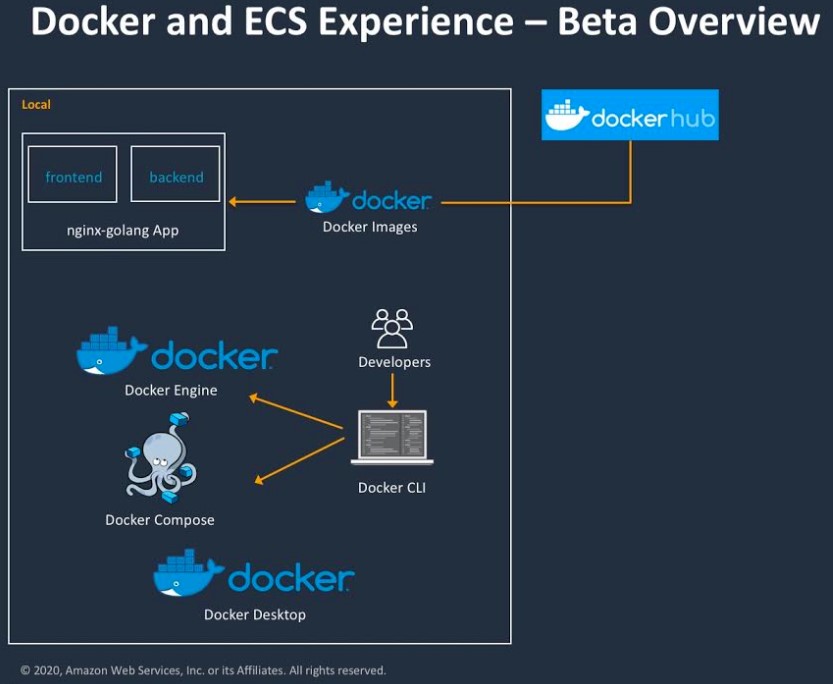
Docker and AWS today announced a new collaboration that introduces a deep integration between Docker’s Compose and Desktop developer tools and AWS’s Elastic Container Service (ECS) and ECS on AWS Fargate. Previously, the two companies note, the workflow to take Compose files and run them on ECS was often challenging for developers. Now, the two companies simplified this process to make switching between running containers locally and on ECS far easier .
“With a large number of containers being built using Docker, we’re very excited to work with Docker to simplify the developer’s experience of building and deploying containerized applications to AWS,” said Deepak Singh, the VP for Compute Services at AWS. “Now customers can easily deploy their containerized applications from their local Docker environment straight to Amazon ECS. This accelerated path to modern application development and deployment allows customers to focus more effort on the unique value of their applications, and less time on figuring out how to deploy to the cloud.”
In a bit of a surprise move, Docker last year sold off its enterprise business to Mirantis to solely focus on cloud-native developer experiences.
“In November, we separated the enterprise business, which was very much focused on operations, CXOs and a direct sales model, and we sold that business to Mirantis,” Docker CEO Scott Johnston told TechCrunch’s Ron Miller earlier this year. “At that point, we decided to focus the remaining business back on developers, which was really Docker’s purpose back in 2013 and 2014.”
Today’s move is an example of this new focus, given that the workflow issues this partnership addresses had been around for quite a while already.
Quantum computing startup IonQ today announced that it has raised additional funding as part of its previously announced Series B round. This round extends the company’s funding, including its 2019 $55 million Series B round, by about $7 million and brings the total investment into IonQ to $84 million.
The new funding includes strategic investments from Lockheed Martin and Robert Bosch Venture Capital, as well as Cambium, a relatively new multi-stage VC firm that specializes in investing “in the future of computational paradigms.”
In addition to the new funding, College Park, Maryland-based IonQ also announced a number of additions to its advisory team, including 2012 Nobel Prize winner David Wineland, who worked with IonQ co-founder and chief scientist Christopher Monroe on building the first quantum logic gate back in 1995.
Other new advisors are Berkeley Quantum Computation Center co-director Umesh Vazirani, former Cray senior VP of R&D Margaret (Peg) Williams, and Duke associate professor Kenneth Brown.
Image Credits: IonQ /
IonQ made an early bet on trapped ions at the core of its quantum computers, which is no surprise, given Monroe’s early work in this field.
“We’re doing something which, at least initially, was thought of as kind of against the grain for quantumAnd what that is is trapped ion computers, which isions which are being suspended in a vacuum and using electromagnets to hold them. So our cubits are our individual ions,” said IonQ CEO and president Peter Chapman, who was Amazon’s director of engineering for Amazon Prime before he took this new role last year. This approach has its pros and cons, Chapman explained. It makes it easier for the company to create its qubits, for example, which lets it focus on controlling them. In addition, IonQ’s machines can run at room temperature, while most of its competitors (with maybe the exception of Honeywell, which is also betting trapped ions at the core of its quantum computer) have to cool their machines to as close to zero Kelvin as possible.
One negative — at least for the time being, though — is that the trapped ion technique makes for a relatively slow quantum computer. But Chapman mostly dismissed the critique. “People say that the trapped ion computers are slow and that is true in the current generation. But slow is relative here. We run a thousandtimes slower or something. But at the end of the day, speed is one of those things that matters when you have two systems which can do the same thing. Then you care about the speed. If only one of the two systems can do your calculation, then it probably doesn’t matter.”
Image Credits: IonQ /
Like so many other quantum computing startups, IonQ is still mostly in its research and development phase and doesn’t currently have any revenue. That will change, though, Chapman noted, once Amazon and Microsoft start making its systems available in their clouds (something both vendors have already announced).
Until then, the new funding will go almost exclusively into R&D and Chapman noted that the team is currently working on the next three generations of its systems already.
Both Lockheed Martin and Bosch have made a number of investments in various quantum technologies and Chapman noted that Lockheed actually provided the initial grand money for IonQ co-founder Chris Monroe’s research during his time at the University of Maryland.
from Amazon – TechCrunch https://techcrunch.com/2020/06/16/ionq-raises-additional-funding-for-its-quantum-computing-platform/
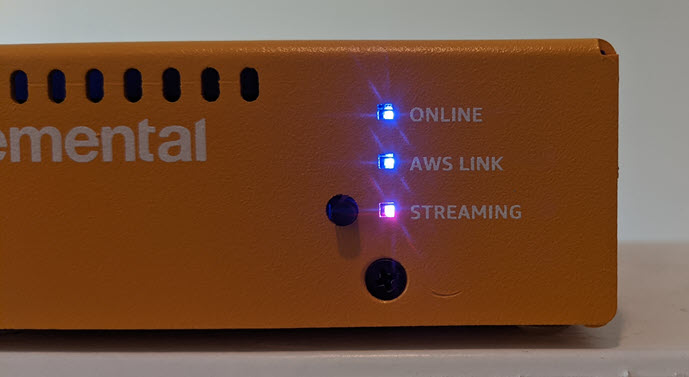
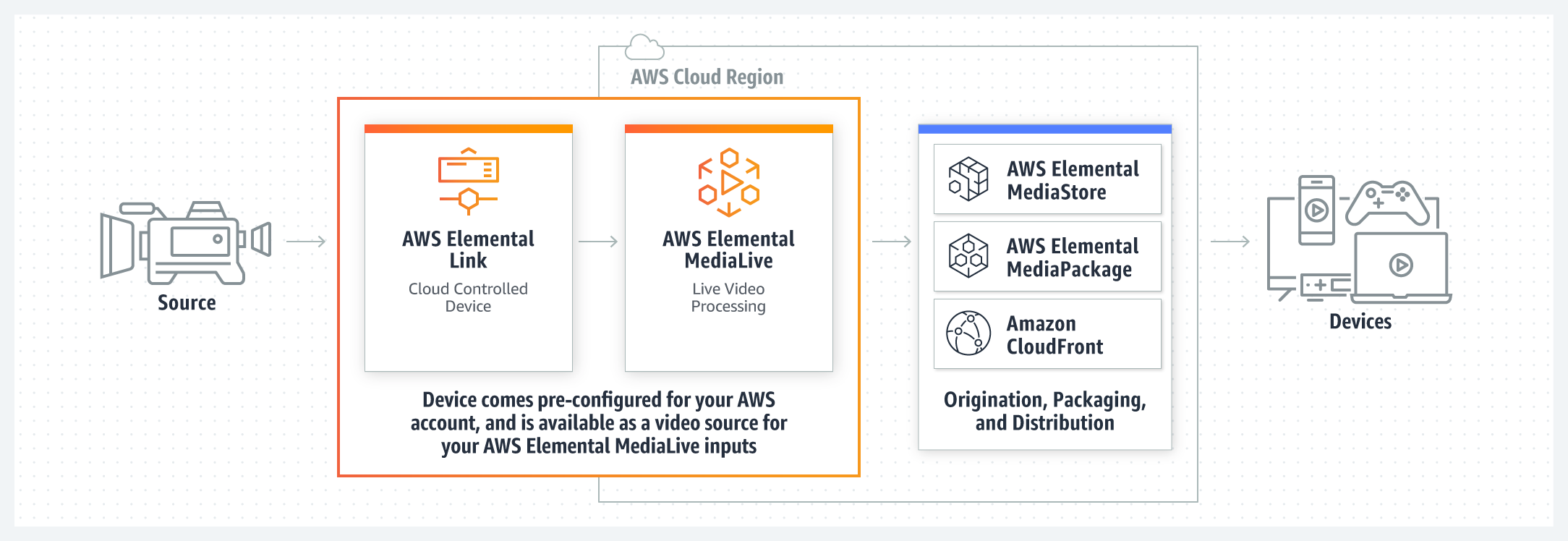
AWS today announced the launch of the Elemental Link, a small hardware device that makes it easy to connect a live video source to the AWS Elemental Media Live service for broadcast-grade live video processing in the cloud. The $995 Link, which weighs in at less than a pound, is meant to allow Media Live users to connect a camera or video production setup to the AWS cloud.
The fanless Link has an Ethernet port and inputs for either an HD-SDI or HDMI cable. In the AWS Management Console, it’ll show up as a media source for MediaLive and it’ll automatically adapt the streaming video based on available bandwidth.
“In sophisticated environments, dedicated hardware and an associated A/V team can capture, encode, and stream or store video that meets these expectations,” explains AWS’s Jeff Barr in today’s announcement. “However, cost and operational complexity have prevented others from delivering a similar experience. Classrooms, local sporting events, enterprise events, and small performance spaces do not have the budget or the specialized expertise needed to install, configure, and run the hardware and software needed to reliably deliver video to the cloud for processing, storage, and on-demand delivery or live streaming.”
Amazon obviously has quite a bit of experience with streaming video, not only because of the broadcast networks it partners with but also thanks to Twitch.
The Link devices aren’t meant for Twitch streamers, though. AWS is clearly targeting these devices at more sophisticated organizations that are already using the AWS cloud for their broadcast infrastructure. And while the Link takes away some of the complexities of managing the streaming hardware, the MediaLive cloud piece isn’t exactly as trivial to manage as the more consumer-grade live streaming platforms available today. For those platforms, OBS Studio and a maybe a prosumer switcher like the Blackmagic ATEM Mini is all you need to get started with a multi-camera setup anyway.
Barr says AWS is working on a CloudFormation-powered solution that can take care of setting up the output from MediaLive and make actually doing something with the video that’s coming from the Link devices a bit easier.
from Amazon – TechCrunch https://techcrunch.com/2020/05/04/aws-launches-the-995-elemental-link-for-streaming-video-to-its-cloud/
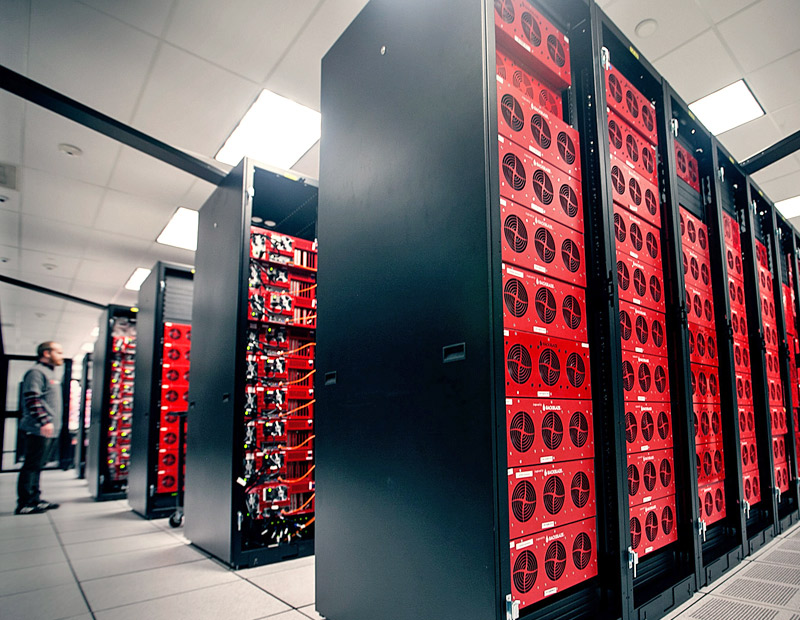
Backblaze started out as an affordable cloud backup service but over the last few years, the company has also taken its storage expertise and launched the developer-centric B2 Cloud Storage service, which promises to be significantly cheaper than similar offerings from the large cloud vendors. Pricing for B2 starts at $0.005 per GB/month. AWS S3 starts at $0.023 per GB/month.
The storage price alone isn’t going to make developers switch providers, though. There are some costs involved in supporting multiple heterogeneous systems, too.
By making B2 compatible with the S3 API, developers can now simply redirect their storage to Backblaze without the need for any extensive rewrites.
“For years, businesses have loved our astonishingly easy-to-use cloud storage for supporting
them in achieving incredible outcomes,” said Gleb Budman, the co-founder and CEO of
Backblaze. “Today we’re excited to do all the more by enabling many more businesses to use
our storage with their existing tools and workflows.”
Current B2 customers include the likes of American Public Television, Patagonia and Verizon’s Complex Networks (with Verizon being the corporate overlords of Verizon Media Group, TechCrunch’s parent company). Backblaze says it has about 100,000 total customers for its B2 service. Among the launch partners for today’s launch are Cinafilm, IBM’s Aspera file transfer and streaming service, storage specialist Quantum and cloud data management service Veeam.
“Public cloud storage has become an integral part of the post-production process. This latest enhancement makes Backblaze B2 Cloud Storage more accessible—both for us as a vendor, and for customers,” said Eric Bassier, Senior Director, Product Marketing at Quantum. “We can now use the new S3 Compatible APIs to add BackBlaze B2 to the list of StorNext compatible public cloud storage targets, taking another step toward enabling hybrid and multi-cloud workflows.”
from Amazon – TechCrunch https://techcrunch.com/2020/05/04/backblaze-challenges-aws-by-making-its-cloud-storage-s3-compatible/