Monday, March 30, 2020

Stratolaunch reveals updated fleet, including two hypersonic aircraft and a space plane

High-altitude launch startup Stratolaunch has gone through some changes, but on Monday it revealed design details of two hypersonic aircraft, along with a space plane, all designed to take-off from its flying carrier plane launch platform. If all goes to plan, test flights of the first of these new vehicles will begin in 2022, and the company says it’s fully funded to be able to get to that point.

Stratolaunch was originally founded in 2011 by Microsoft co-founder Paul Allen. Allen unfortunately passed away last year, and the company is now led by a group of investors led by Steve Feinberg. The new ownership is still tracking towards the original goal of the company, however, which is to develop hypersonic atmospheric aircraft.

On Monday, it also unveiled an extension of its mission to get into spaceflight via a new space plane that could potentially carry both cargo and crew. It’s designed to be fully reusable, and is meant to both take up and return cargo with conventional runway landing capabilities.

Stratolaunch’s first goal, however, will be to bring its Talon A hypersonic autonomous aircraft to life. Also designed for full reusability, the Talon A will measure roughly 28 feet in length, and have an 11.3-foot wingspan. It’s designed to fly for over a minute in hypersonic mode for testing, and then slide back down for a fully autonomous landing on a standard runway. The aircraft will not only be able to be deployed from the Stratolaunch carrier aircraft, but will also be designed to take-off on its own autonomously, also like a traditional aircraft from a standard runway.

The aircraft’s main purpose is to provide a testbed for various types of instrumentation and data gathering during hypersonic flight – it’s essentially a lab that can provide real-world experience of something perviously available only in simulation. Up to three of the Talon A vehicles can be transported and launched from one of Stratolaunch’s carrier aircraft at once.

Talon Z, meanwhile, looks to be a larger hypersonic aircraft, but Stratolaunch isn’t sharing much more in the way of details about its capabilities or intended purpose yet. The Black Ice space plane will likewise probably mostly serve customers looking for orbital experimentation, but its cargo and future potential crew capabilities could actually make it well-suited to orbital logistics and potentially even satellite deployment capabilities.

Stratolaunch’s approach with Black Ice is somewhat akin to what Virgin Galactic and Virgin Orbit are doing for commercial passenger spaceflight and small satellite cargo, respectively. The two Virgin companies also use traditional take-off aircraft as the launch platforms for their vehicles, but they’re much further along in their development program. Stratolaunch did complete the first test flight of its carrier aircraft last year, and is aiming to have Talon A ready for commercial service by 2023.


from Microsoft – TechCrunch https://techcrunch.com/2020/03/30/stratolaunch-reveals-updated-fleet-including-two-hypersonic-aircraft-and-a-space-plane/

GenC

It doesn’t really pay to classify multitudes by their age–every generation is complex and intermingles with all the others.

But it might be a useful way to understand the issues we’ve faced and where we might be heading.

Generation C was inaugurated with the events created by Covind-19, and it is defined by a new form of connection.

There’s a juxtaposition of the physical connection that was lost as we shelter in place, and the digital connection that so many are finding online.

Not just a before and after for the economy, but for culture, for health, for expectations. School and jobs are different now, probably for the long term.

No idea or behavior shift has ever spread more quickly or completely in the history of the planet. In seven weeks, the life of every single person on Earth changed, and the unfolding tragedy and the long slog forward will drive expectations for years. Expectations about being part of a physical community, about the role of government and about what we hope for our future.

If previous cycles of media were about top-down broadcast (from radio, TV and cable), the last few years have been about the long tail, about giving a microphone to anyone who wanted one. But now, the peer to peer power of the internet is dominating. The Kardashians won’t be as important as 3,000 people with a thousand connections each. Never mind a million people with 100 each.

Companies are now competing to see how few employees they have instead of how many. The lattices of the connection economy are racing to replace the edifice complex of the previous one.

And if Covind-19 and Connection are the first two C’s, the third one is going to be Carbon.

Because we’re going to need to pay. All of us. To pay for the dislocations and to pay for the treatment and to pay for the recovery.

Worldwide cataclysms are different from local ones. As we shift gears and seek to revitalize our economy, put people to work and build a resilient future, it might be tempting to drill and burn, and to try to adopt an emergency footing that disregards any long-term future more than a few months ahead. But GenC may be too wise for that. And they may be connected enough to speak up and overrule the baby boomers.

A threat and an enemy will focus public attention. For a long time, that enemy was other people or other nations, and an us-vs-them mindset was a great way to get attention or get elected. But just as we came to understand that you can’t bully a virus, you can’t personalize carbon either.

The worldwide challenge of carbon is not a problem for someone else, it’s a problem for all of us. Using carbon consumption as a way to pay for rebuilding our community brings all three Cs together.

Emergencies are overrated as a response mechanism. Preparation and prevention are about to become a more popular alternative.

My generation was the dominant voice for sixty years. A voice that worried about the next 24 hours, not the next 24 years. That’s about to shift, regardless of what year you were born.

What can we do that matters instead?


from Seth Godin's Blog on marketing, tribes and respect https://feeds.feedblitz.com/~/620532300/0/sethsblog~GenC/

Sunday, March 29, 2020

Divesting from one facial recognition startup, Microsoft ends outside investments in the tech

Microsoft is pulling out of an investment in an Israeli facial recognition technology developer as part of a broader policy shift to halt any minority investments in facial recognition startups, the company announced late last week.

The decision to withdraw its investment from AnyVision, an Israeli company developing facial recognition software, came as a result of an investigation into reports that AnyVision’s technology was being used by the Israeli government to surveil residents in the West Bank.

The investigation, conducted by former U.S. Attorney General Eric Holder and his team at Covington & Burling, confirmed that AnyVision’s technology was used to monitor border crossings between the West Bank and Israel, but did not “power a mass surveillance program in the West Bank.”

Microsoft’s venture capital arm, M12 Ventures, backed AnyVision as part of the company’s $74 million financing round which closed in June 2019. Investors who continue to back the company include DFJ Growth and OG Technology Partners, LightSpeed Venture Partners, Robert Bosch GmbH, Qualcomm Ventures, and Eldridge Industries.

Microsoft first staked out its position on how the company would approach facial recognition technologies in 2018, when President Brad Smith issued a statement calling on government to come up with clear regulations around facial recognition in the U.S.

Smith’s calls for more regulation and oversight became more strident by the end of the year, when Microsoft issued a statement on its approach to facial recognition.

Smith wrote:

We and other tech companies need to start creating safeguards to address facial recognition technology. We believe this technology can serve our customers in important and broad ways, and increasingly we’re not just encouraged, but inspired by many of the facial recognition applications our customers are deploying. But more than with many other technologies, this technology needs to be developed and used carefully. After substantial discussion and review, we have decided to adopt six principles to manage these issues at Microsoft. We are sharing these principles now, with a commitment and plans to implement them by the end of the first quarter in 2019.

The principles that Microsoft laid out included privileging: fairness, transparency, accountability, non-discrimination, notice and consent, and lawful surveillance.

Critics took the company to task for its investment in AnyVision, saying that the decision to back a company working with the Israeli government on wide-scale surveillance ran counter to the principles it had set out for itself.

Now, after determining that controlling how facial recognition technologies are deployed by its minority investments is too difficult, the company is suspending its outside investments in the technology.

“For Microsoft, the audit process reinforced the challenges of being a minority investor in a company that sells sensitive technology, since such investments do not generally allow for the level of oversight or control that Microsoft exercises over the use of its own technology,” the company wrote in a statement on its M12 Ventures website. “Microsoft’s focus has shifted to commercial relationships that afford Microsoft greater oversight and control over the use of sensitive technologies.”


from Microsoft – TechCrunch https://techcrunch.com/2020/03/29/divesting-from-one-facial-recognition-startup-microsoft-ends-outside-investments-in-the-tech/

Elizabeth Warren for President open-sources its 2020 campaign tech

Democratic senator Elizabeth Warren may have ended her 2020 presidential run, but the tech used to drive her campaign will live on.

Members of her staff announced they would make public the top apps and digital tools developed in Warren’s bid to become the Democratic nominee for president.

“In our work, we leaned heavily on open source technology — and want to contribute back to that community…[by] open-sourcing some of the most important projects of the Elizabeth Warren campaign for anyone to use,” the Warren for President Tech Team said.

In a Medium post, members of the team — including chief technology strategist Mike Conlow and chief technology officer Nikki Sutton — previewed what would be available and why.

“Our hope is that other Democratic candidates and progressive causes will use the ideas and code we developed to run stronger campaigns and help Democrats win,” the post said.

Warren’s tech team listed several of the tools they’ve turned over to the open source universe via GitHub.

One of those tools, Spoke, is a peer to peer texting app, originally developed by MoveOn, which offered the Warren Campaign high volume messaging at a fraction of the costs of other vendor options. The team used it to send four million SMS messages on Super Tuesday alone.

Pollaris is a location lookup tool with an API developed to interface directly with Warren’s official campaign website and quickly direct supporters to their correct polling stations.

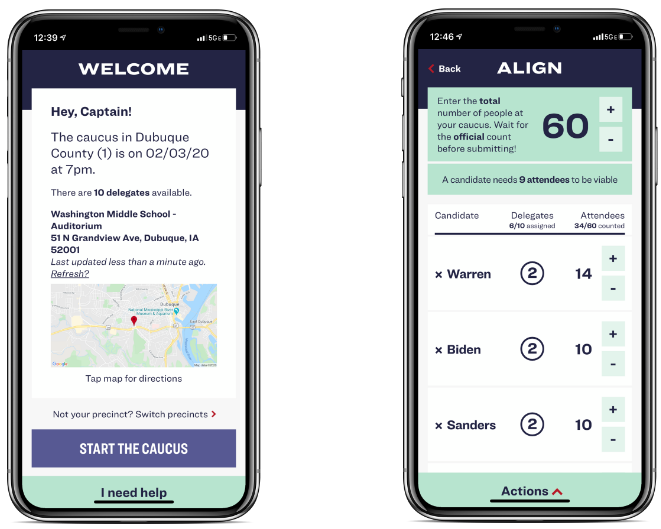
One of Elizabeth Warren’s presidential campaign app, Caucus, designed for calculating delegates. (Image: supplied)

Warren’s tech team will also open-source Switchboard (FE and BE) — which recruited and connected volunteers in primary states — and Caucus App, a delegate calculating and reporting tool.

The campaign’s Redhook tool took in web hook data in real time and experienced zero downtime.

“Our intention in open sourcing it is to demonstrate that some problems campaigns face do not require vendor tools and are solved…efficiently with a tiny bit of code,” said the Tech Team.

Elizabeth Warren ended her 2020 presidential bid on March 4 after failing to win a primary. Among her many policy proposals, the Massachusetts senator had proposed breaking up big tech companies, such as Google, Facebook and Amazon.

Her campaign will continue to share the tech tools they used on open source channels.

“We’ll have more to say in the coming weeks on all that we did with technology on our campaign,” the team said.


from Amazon – TechCrunch https://techcrunch.com/2020/03/29/warren-open-source-campaign-tech/

“I’ll go with my principles tomorrow”

In the short run, it’s easy to abandon what we believe. Deep down, we assume that once things go back to normal, so will we.

Organizations end up with bullies, predators and bad actors for only one reason: In this moment, it’s easier to keep them. There’s some sort of urgency that makes asking them to leave too difficult right now, so we put it off for a little while. When we make a “just this once” exception, we’ve already made a decision about what’s truly important.

And the same goes for those moments when we’re inclined to be, just for a moment, a bully, a predator or a bad actor as well. Few people decide to be selfish for the long haul.

What makes it a principle is that we do it now, even though (especially though) it’s hard.


from Seth Godin's Blog on marketing, tribes and respect https://feeds.feedblitz.com/~/620490296/0/sethsblog~Ill-go-with-my-principles-tomorrow/

Saturday, March 28, 2020

Communicating online (the big leaps)

It’s not just like the real world but with keyboards.

Leap 1: Attention is too easy to steal online, so don’t. Spam is a bad idea. Interrupting hundreds or millions of people doesn’t cost you much, but costs each person a lot. You wouldn’t stand up in the middle of a Broadway play and start selling insurance from the audience. Don’t do it with your keyboard. Permission is anticipated, personal and relevant.

Leap 2: There’s a difference between asynchronous and synchronous interaction. We know this intuitively in the real world (a letter is different from a phone call) but online, it’s profound. A discussion board isn’t the same as a Zoom call. It turns out that we can create rich and layered conversations with async communication, but we also have to be just a bit more patient.

Leap 3: More than one person can ‘talk’ at a time. In the real world, that’s impossible. At a table for six, we take turns talking. But in a chat room, we can all talk at the same time. Use it well and you can dramatically increase information exchange. But if you try to follow all the threads, or you miss what you need, then it’s actually less effective.

Leap 4: Sometimes we leave a trail. Most real-life conversations are inherently off the record because the words disappear right after we say them. But if you use a keyboard, or you’re attached to a server, assume you’re being recorded and act appropriately. And sometimes the people who are talking are anonymous (which never happens in the real world).

It’s possible, with effort, to transform business communications (and schooling) away from the top-down, synchronized, compliance-focused, off-the-record, hierarchical and slow status quo to something significantly more fluid and powerful. But we’ll need to do it on purpose.


PS the free co-working space we’re offering has become a successful community hub. Thanks to the Akimbo team for putting so much into creating it, and for the thousands of people who have found energy and solace by being part of it.


from Seth Godin's Blog on marketing, tribes and respect https://feeds.feedblitz.com/~/620454422/0/sethsblog~Communicating-online-the-big-leaps/

Friday, March 27, 2020

Target pauses plans for grocery pickup amid COVID-19 outbreak

Target is pausing its plans to offer curbside pick-up of groceries and alcoholic beverages, citing the COVID-19 outbreak as the key factor in its decision to delay the launch. Although groceries via Order Pickup and Drive Up would be valuable services at a time when people are being asked to distance themselves from others to prevent the spread of the novel coronavirus, Target says it won’t have time to train employees on these new processes right now.

Like many retailers and grocers, Target is impacted by the COVID-19 outbreak, which is significantly changing the way people shop. People are more likely to buy in bulk to minimize trips to the store. And many are panic-buying critical supplies, like toilet paper. Target says it has seen a sustained surge in both traffic and sales, particularly in food and beverage and other household essentials, like cleaning supplies and baby products. Other categories, including apparel and accessories, have slowed.

The launch of any new system or process takes time to adjust to, even when there’s ample time to train. But Target’s staff today is working at increased levels — its March sales are 20% higher than March of last year, as a point of comparison.

Like everywhere, Target also faces staffing concerns as people scramble to figure out childcare when schools are closed. It will have to reassess employee schedules on the fly, as staff members leave unexpectedly when they or a family member gets sick. There also have been a small number of cases where Target employees themselves have tested positive for the virus. And as the outbreak spreads, more will likely be exposed, given their continual contact with the public.

To address these concerns, Target is cleaning its stores regularly, promoting social distancing, wiping down carts, adding signage to guide guests, cleaning checklanes after each transaction and more. It’s also stopping in-store returns for three weeks, but will honor later returns when the ban is lifted. And it’s pausing its small-format store openings and remodels planned for this year — shifting those to 2021, given the chaos around its business today.

To assist employees, Target announced that it’s investing more than $300 million in added wages, a new paid leave program, bonus payouts and relief fund contributions.

Though Target won’t roll out curbside fresh grocery pickup now, it continues to operate the grocery delivery business Shipt. This and other grocery delivery services are booming due to the outbreak. Instacart this week said it was hiring 300,000 more full-service shoppers due to coronavirus. Walmart, CVS, Amazon and other U.S. employers are hiring more than 800,000 new workers due to the COVID-19 impacts.


from Amazon – TechCrunch https://techcrunch.com/2020/03/26/target-pauses-plans-for-grocery-pickup-amid-covid-19-outbreak/